The Story
Why it exists.
The beginning
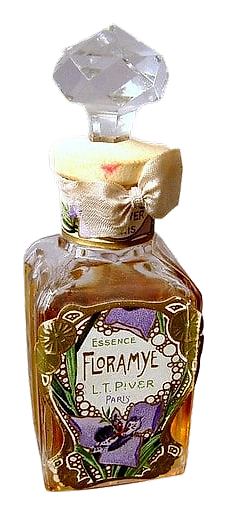
Pierre Armigeant composed Floramye in 1905, and the name itself does most of the telling. Flora, Latin for flower. Mye, a suffix that smells like invention, the kind a perfumer reaches for when he wants to signal that something has been rearranged, taken apart and rebuilt into a shape nature never offered. Armigeant wasn't hiding what he'd done. He was naming it. The composition sits inside a moment when French perfumery was beginning to think with synthetic materials as fluently as with flowers, and Floramye carries that shift in its bones. You smell it and you understand that this isn't an arrangement of petals anymore. It's a hypothesis about what flowers could become once the lab got involved, once aldehydes became vocabulary instead of novelty. The name promises a flower.
What's striking about Floramye is how deliberately it refuses softness. The iris arrives green and dry, almost stem-like, carrying the cool, slightly bitter character of orris rather than the plush, cosmetic iris that later perfumery would normalize. Armigeant layered aldehydes against animalic notes, and the result has a tension that holds the whole composition upright. The aldehydes provide that fizzy, sparkling lift, the signature shimmer of the era, while the animalic base keeps everything grounded, slightly furred, warm in a way that never turns sweet.
The evolution
The opening belongs entirely to the aldehydes, that fizzy, almost metallic brightness that made the early twentieth century smell like electricity and optimism. There's no easing in. The sparkle lands first and asks questions later. Then the iris arrives, green and rooty, cutting through the shimmer with something cooler, more mineral, the cool side of orris rather than its powdered sweetness. Underneath, the floral heart blooms quietly, never fully taking over, more like texture than centerpiece, a suggestion of petals held at arm's length. As the hours pass, the animalic notes surface, warm and slightly fur-like, the composition's secret handshake, the part that keeps it honest and prevents the aldehydes from floating off into abstraction.
Cultural impact
Floramye holds a particular fascination for those who collect and study early aldehydic florals. Its angular construction and its refusal to soften into prettiness mark it as something distinct from the better-known compositions of the same era, and that distinctiveness is part of why it continues to attract attention. The fragrance rewards a certain kind of curiosity, the willingness to engage with a composition that doesn't perform for an audience so much as hold its shape for the wearer.