The Story
Why it exists.
The beginning
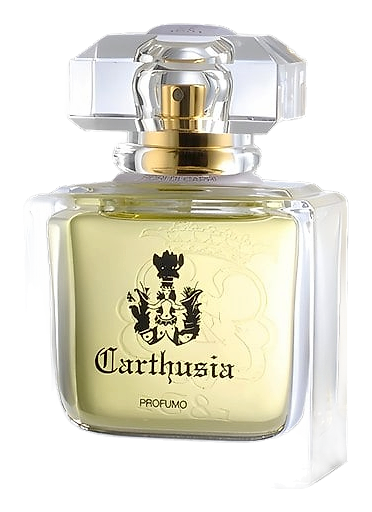
Fiori di Capri is Carthusia's original. The house has been turning Capri's fragrant landscape into perfume since 1948, rooted in formulas uncovered at the Certosa di San Giacomo monastery. Nearly seven decades later, Laura Bosetti Tonatto composed this parfum concentration, taking the house's foundational idea and pushing it toward something richer, more intimate, a denser exploration of the florals that started it all.
The parfum concentration adds weight without losing the refinement of the original. Lily of the valley and wild carnation carry a natural duality, delicate on the surface, with an edge underneath. Against amber and sandalwood, these florals don't just smell pretty. They hold their ground. Oakmoss and white musk provide the structural counterweight, giving the composition its chypre backbone.
The evolution
The opening is bright and delicate, Lily-of-the-Valley greeting you first with its crisp, green-floral lift while Carnation arrives alongside with a soft, peppery spice that keeps things interesting. The combination reads as quietly elegant rather than loud. Ylang-Ylang swells into the heart, bringing its characteristic rich, tropical floral sweetness that feels warm and enveloping. The carnation's spice continues to ground this phase, adding depth beneath the creamy floral richness. For a brief moment the fragrance feels lush and full. Then the transition begins. As the florals begin to settle, the base notes quietly assert themselves. Oakmoss takes its place, mossy, deep, with that characteristic chypre earthiness that anchors the composition. Ambergris appears as the florals fade, giving the base a mineral, slightly salty depth that feels almost coastal.
Cultural impact
Fiori di Capri occupies a particular space in the Carthusia line, foundational to the house's identity, composed with the perspective of decades rather than the urgency of a trend. The chypre-floral balance gives it a classical structure that has endured for good reason. The oakmoss and ambergris keep it from feeling dated, while the ylang-ylang heart adds a warmth that feels timeless rather than nostalgic. It's the kind of fragrance that rewards patience, revealing its nuances slowly rather than announcing itself all at once.