The Story
Why it exists.
The beginning
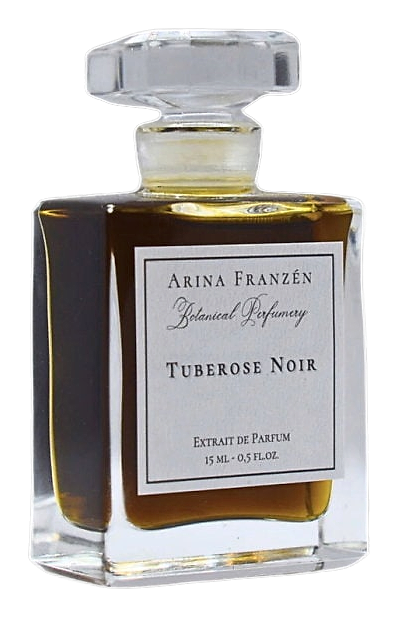
Tuberose Noir was the scent that opened Volume I of Arina Franzén's numbered catalog, released in 2023 as an extrait de parfum. The name tells you the intention: a tuberose that turns away from the bright, creamy, almost cheerful reading the flower usually gets. Noir signals a darker register, a bloom rendered in shadow rather than sunlight, and from the opening spritz you can sense the composer steering the flower away from its sunlit, dewy associations toward something more opaque and considered. Coming from a maker with a botanical sensibility, the composition leans into materials that carry their own weight and presence. The accord doesn't announce itself with the sugary sweetness that so often flattens white-flower compositions.
What makes Tuberose Noir structurally unusual is the way Franzén frames the flower. Tuberose shares the heart with five other florals (iris, jasmine sambac, magnolia, pink lotus, ylang-ylang), so it never appears alone. It arrives through a crowd, filtered, which gives it a softer entrance than most tuberose-led compositions. The coconut in the opening and the carrot seed, false sandalwood, hay, and maté in the base carry an earthy, almost herbal backbone.
The evolution
The first thirty minutes belong to coconut and pink pepper, a bright, almost sun-warmed entry that feels lighter than expected. Petitgrain sur Fleurs adds a green, leafy snap that keeps the opening from sliding into anything overtly sweet. Then the florals arrive, and they arrive as a group. Tuberose, jasmine sambac, magnolia, ylang-ylang, pink lotus, and iris bloom together in a dense, creamy wave that doesn't differentiate itself note by note so much as fill the air as a single white mass. The indolic edge of real tuberose absolute starts to show here, that warm, almost animal undertone that some people find hypnotic and others find challenging. By the second hour, the base takes over: carrot seed brings a dry, rooty warmth, false sandalwood smooths out the texture, hay adds a sun-dried grassy quality, and maté contributes a tannic, tea-like bitterness. The drydown is where this fragrance earns its name. The white flowers recede but never fully leave.
Cultural impact
Among those who have encountered Tuberose Noir, the fragrance is often described as a tuberose that doesn't behave like a tuberose, a floral that pulls the bloom away from the creamy, bridal-adjacent territory the flower typically occupies. Two reviewers describe it in terms that point to the same quality: a tuberose for someone who already loves the note but wants something that doesn't read as a repeat of the category.