
The Story
Why it exists.
The beginning
The idea arrived at Handmade 2011, the design exhibition where Wallpaper*, publisher Gerhard Steidl, and perfumer Geza Schön asked a simple question: why has no fragrance ever faithfully reproduced the smell of a freshly printed book? Steidl had been obsessed with that scent for decades. Schön had never worked with anything like it. Paper has no intrinsic fragrance, the smell comes from the printing process itself, from the chemicals and inks and paper molecules interacting. Schön spent months isolating the exact volatile compounds released during that process, building an accord from scratch using synthetic molecules that had never been combined this way. The result was a fragrance constructed entirely around a single sustained idea, the printed page as sensory experience.
The real departure was structural. Most fragrances operate as narratives with beginnings, middles, and endings. Paper Passion doesn't follow that logic. Instead of a traditional top-heart-base pyramid with distinct phases, Schön built a single continuous accord that captures what a book means from cover to cover: the sharp crack of the spine, the warmth of pages held close, the dusty quiet of an old volume. Osmanthus threads through the composition not as a conventional heart note but as a quiet counterweight, its apricot-like sweetness prevents the whole thing from reading as purely cerebral. The amber in the base isn't warmth in the traditional sense. It's the warmth of a reading lamp. Of proximity.
The evolution
The opening hits like a book snapped open for the first time, ozone-sharp, a flash of ink, the slightly electric smell of paper just off the press. There's no gentle bloom here. It arrives fully formed, the way the first sentence of a great book does. Within twenty minutes the ozone recedes and the paper accord takes over, not dry or papery in the way that suggests weakness, but rich and slightly bitter, like high-quality paper stock. The osmanthus surfaces gradually, not as a floral note exactly, but as a warmth, the sweetness of afternoon light on a page, barely there but unmistakable. The drydown is the longest phase and the most personal: a soft, resinous amber that settles close to the skin, lingering for 6-8 hours depending on application. On fabric, it can last even longer, the ghost of a bookmark, or a book left open on a nightstand.
Cultural impact
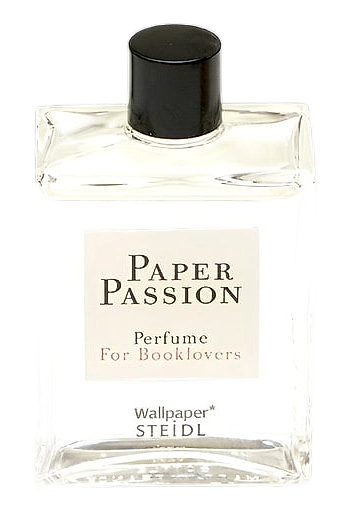
Paper Passion occupies an unusual position: it's a fragrance born from a concept so specific it can feel exclusionary, yet executed with enough intellectual rigor that it transcends novelty. The collaboration between Wallpaper*, Steidl, and Schön is itself a statement about the relationship between design, print culture, and fragrance, three disciplines that don't often share a room. Karl Lagerfeld's contribution is worth noting separately: the bottle is designed to look like a closed hardcover book, which means the object itself is part of the statement. This is a fragrance that works as sculpture, as design object, and as perfume simultaneously.