
The Story
Why it exists.
The beginning
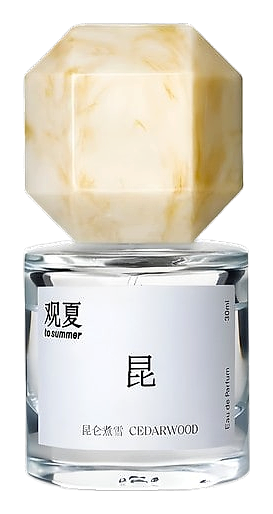
The name 昆仑煮雪 translates roughly to 'Kunlun Simmers Snow', a reference to the mythical Kunlun Mountains in Chinese cosmology, said to be the dwelling place of the Queen Mother of the West. To Summer drew inspiration from these alpine heights, creating a fragrance that captures the stillness of snow-capped peaks and the clarity of thin mountain air. The perfumers set out to translate this into scent, not through incense or smoke, but through the crispness of evergreen forests and the warmth of cedarwood. The crispness of evergreen forests mingles with the warmth of cedarwood, creating a continuous woody thread throughout the composition. Jasmine appears first, delicate and slightly indolic, followed by rose that reads quieter and more austere.
What makes Cedarwood distinctive is its use of Chinese cedarwood as the structural backbone, not a supporting note but the defining material. Paired with guaiac wood and amber in the base, the cedar creates a warm, grounding drydown that contrasts beautifully with the cool green opening of pine and juniper. The addition of jasmine and rose in the heart prevents the composition from reading as purely masculine or austere; there's a softness here that balances the coniferous sharpness. Bergamot and cypress lift the top with a citrusy freshness that reads as clean rather than bright, the scent of cold air, not summer fruit.
The evolution
The opening arrives crisp and green, pine needle sharpness, juniper berry brightness, bergamot cutting through like cold morning air. Cypress adds an herbal, slightly camphoraceous quality that grounds the citrus and keeps things from smelling sweet. As the composition evolves, the heart takes over: jasmine appears first, delicate and slightly indolic, followed by rose, not a rosy-rose but something quieter, more austere. Cedarwood is the dominant player throughout, both as heart and base material, giving the composition a continuous woody thread that keeps everything cohesive. The drydown shifts toward warmth, amber and guaiac wood arrive to soften the edges, extending the cedar into something almost resinous. The overall effect is intimate rather than projecting, projecting close rather than filling a room, with sillage that remains refined throughout wear.
Cultural impact
Cedarwood sits comfortably within To Summer's Eastern Essence collection, fragrances that translate Chinese cultural motifs into contemporary perfumery. The house draws on a deep reservoir of Chinese cultural heritage, reinterpreting traditional references through a modern lens. Cedarwood represents a particularly compelling entry in this collection, one that uses the wood's natural resonance to explore themes of stillness, altitude, and clarity. The fragrance speaks to a growing appetite among consumers for scents that carry meaning beyond novelty, offering something that feels both rooted and innovative.