
The Story
Why it exists.
The beginning
Mandodari takes her name from Thai mythology, the queen consort of Ravana in the Ramayana, known for beauty, piety, and a husband's betrayal that the stories never quite redeemed. Prin Lomros looked at that gap in the narrative and filled it. Not with vengeance. With complexity. The fragrance doesn't whitewash the tragedy; it holds both the divine and the earthly in the same breath, giving Mandodari the arc the myths denied her. This is a perfume about unspoken things, the ones that live beneath the beautiful surface and make the beauty worth looking at.
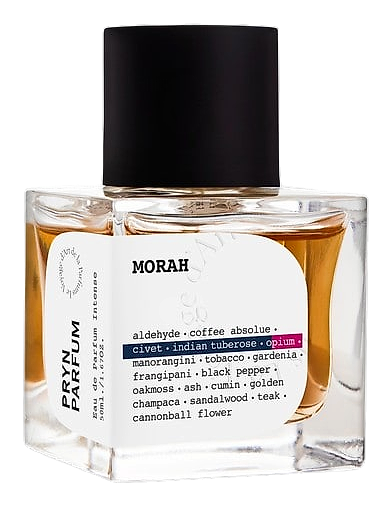
The note structure tells you everything about the intent. Aldehydes lift the white florals into something crystalline and bright, gardenia, frangipani, champaca, tuberose, but they don't stay delicate. Coffee absolute grounds them immediately. Civet introduces animalic warmth that no amount of aldehydic sparkle can fully polish. Ash and tobacco add a smoky, resinous darkness that builds as the florals soften. Oakmoss and teakwood anchor everything in damp earth. It's a composition that respects its own contradictions: beauty isn't innocent here, and darkness isn't cruel. It's just honest about what it costs to be luminous.
The evolution
The aldehydes hit first, bright, cold, a little metallic. Gardenia arrives quick and narcotic, followed by frangipani's sweet cream. But the coffee is already there, waiting underneath. Thirty minutes in, the civet emerges. Not aggressive, present. It adds warmth to the florals that makes them feel closer, more human. The tobacco and ash start building around the hour mark, pushing the composition from floral toward chypre. By hour three, the florals have receded into the background, leaving smoke, coffee, and a deep animalic warmth that stays close to the skin. Eight to ten hours later, on fabric especially, you're left with sandalwood and oakmoss, quiet, slightly bitter, the kind of drydown that makes you want to smell your collar again.
Cultural impact
Mandodari occupies a specific corner of niche fragrance, aldehydic florals for people who find classic chypres boring and modern fruity-florals too safe. It draws wearers who've moved past the idea that animalic means aggressive, and who appreciate a fragrance that treats complexity as a feature rather than a flaw. In the landscape of Thai niche perfumery, Prin stands apart from both the tourism-oriented frangrance houses and the Western-aligned luxury brands, offering something quieter and stranger. Mandodari is the label's most explicit statement of that intent: beauty that doesn't apologize for its darkness.