The Story
Why it exists.
The beginning
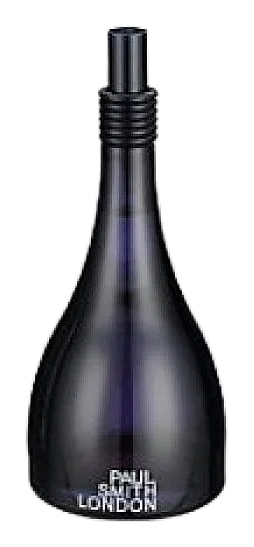
Paul Smith London Men arrived in 2004, a debut from the British house that carried its founder's reputation for a certain kind of considered menswear into bottle form for the first time. The composition went to Antoine Lie, who built it with an eye toward structure and contrast. What came out was an eau de toilette with a longer arc than most of its contemporaries: something that starts clean and green and finishes warm, dense, almost indulgent. The top is vegetal and bright, the base is boozy and resinous, and the distance between them is where the scent lives. Violet leaf and green mandarin open with that cool, leafy snap, while brandy, tonka, amber, and Australian sandalwood settle underneath with a weight you don't expect from the opening.
The composition refuses to pick a lane, and that is what makes it worth paying attention to. Lie blended violet leaf and green mandarin for a vegetal-citrus snap, then layered lavender and mint into the heart. But the base is where the structure earns its character. Brandy, tonka, amber, and Australian sandalwood give it a boozy gravity that the green top never promises. That contrast is the point. The opening doesn't telegraph the drydown, and that mismatch is what makes it memorable on skin rather than on paper.
The evolution
The first 30 minutes are all surface: violet leaf giving that cool, cucumber-skin snap, green mandarin cutting bright across it. By the 45-minute mark, lavender takes the wheel, the kind that carries an herbal clarity rather than the soapy sweetness of an aftershave. Mint arrives alongside it, sharpening the lavender's edges and giving the heart a cool, slightly lifted feel. Jasmine sits in there too, barely registering as its own thing, more a softener than a feature. Around the three-hour mark, the brass begins. Brandy arrives first, warm and dense, then tonka sweetens underneath with a soft, almost vanilla-adjacent warmth. Amber rounds the edges, pulling the whole base into focus. Australian sandalwood holds the structure upright with a creamy, woody steadiness. From hour four onward, it settles into a low, creamy warmth that hugs the skin.
Cultural impact
This 2004 release occupies an interesting position in the brand's scent lineup. Wearers gravitate to it as a transitional piece, too complex for pure office wear, too grounded for evening-only territory. The composition handles a full day without becoming a cloud, reading close to the wearer as the hours pass rather than projecting heavily into a room. Its staying power comes from the base, where brandy, tonka, amber, and Australian sandalwood anchor the lighter green and aromatic notes that open the wear.