
The Story
Why it exists.
The beginning
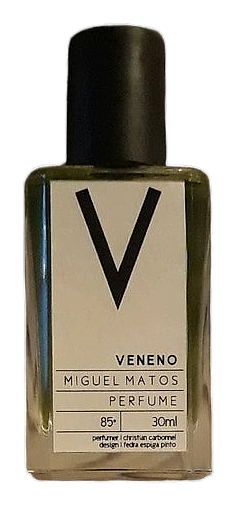
Veneno arrived in 2018 from independent perfumer Miguel Matos, a label built by a man who spent years writing about fragrance before deciding to make it himself. Where most perfumers begin in a lab, Miguel Matos began in criticism. That background shaped everything: the willingness to make something that would genuinely challenge the person wearing it. Veneno, Spanish for poison, is that challenge made literal. The concept isn't subtle: forbidden materials, banned ingredients, the dangerous beauty that regulation tried to eliminate. The composition draws on traditional perfumery materials that modern regulations have restricted or prohibited. Oakmoss, with its characteristic depth, appears alongside other classic elements.
The note pyramid tells you everything about what Veneno is trying to do. Top notes of saffron and narcissus aren't chosen for their crowd-pleasing qualities, they're selected for their capacity to unsettle. Saffron brings that hot, medicinal, slightly fecal edge that no other spice can replicate. Narcissus adds a green, narcotic intensity that borders on intoxicating in the literal sense. The base carries costus, a material so notorious that most houses won't touch it anymore because of its association with "animalic" and "fecal" accords. Here it's not hidden. It's the point.
The evolution
The opening doesn't ease in. It arrives. Saffron and narcissus hit together in the first thirty seconds, a blast of heat and green narcotic intensity that some people recognize as beautiful and some people recognize as too much. There's no middle ground at the start. The osmanthus adds a brief flash of apricot sweetness, but it's gone in minutes, overwhelmed by the stronger personalities in the room. The civet announces itself next. Not politely. This is the phase that defines Veneno's reputation, a raw, animalic musk that smells like the base of a vintage chypre, like something the modern industry decided we shouldn't want anymore. Rose and amber layer over it, adding warmth and darkness without softening the edge. The drydown holds for hours after.
Cultural impact
Veneno occupies a specific and contentious corner of the fragrance world: the forbidden materials conversation. By including oakmoss with atranol, nitro-musks, and costus, ingredients that IFRA restrictions have limited or banned, the composition operates outside the boundaries of what contemporary fragrance development typically permits. Wearers who understand what they're smelling tend to fall into two camps: those who recognize it as a direct line to the intensity of pre-reformulation classics, and those who find it genuinely too much. The fragrance doesn't try to bridge that gap. It was made for the first camp.