The Story
Why it exists.
The beginning
Thé Noir 29 was created by Frank Voelkl and released in 2015. The name carries its own logic, noir as a state of mind, a shade of evening, a quality of attention. Not darkness for its own sake, but the depth that arrives when something is fully itself. The '29' is a Le Labo convention that strips away marketing narrative and replaces it with a number, a stub, a refusal to explain. Le Labo operates on a philosophy that rejects mass production and the idea that luxury means polish. Their fragrances are built for the wearer who chooses with intention, carrying a roughness that feels handmade and personal.
The notes in Thé Noir 29 speak to a specific aesthetic. Fig and bay leaf represent an herbal, slightly unconventional green note that most mainstream fragrances avoid in favor of safer citrus or florals. Cedarwood and vetiver ground the composition in an earthy, woody register that reads as natural rather than constructed. Tobacco and hay in the drydown reinforce the handmade, almost rustic quality that Le Labo pursues. The fragrance pairs with intention. It does not announce itself so much as invite discovery, rewarding the wearer who notices rather than the one who demands attention.
The evolution
The opening registers first as fig, not the sweet pulp but the green skin and leaf, accompanied by the sharp, almost medicinal bite of bay leaf. Bergamot appears briefly, a citrus punctuation that does not linger. As the top notes recede, cedarwood takes position, bringing its dry, slightly turpentine warmth. Vetiver follows, layering earth and faint smoke beneath the wood. Musk smooths the transition, creating the impression of warmth rather than sharpness. The drydown introduces tobacco, not the sweet pipe tobacco but the drier cured leaf, alongside hay, which adds a golden, slightly sweet dryness. The overall arc moves from green and herbal through wood and earth to a warm, dry finish.
Cultural impact
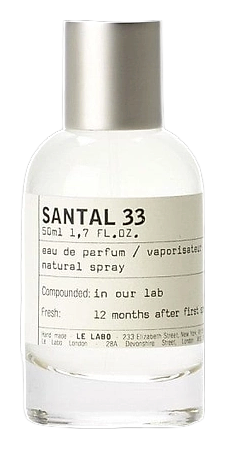
Thé Noir 29 occupies a specific space in the Le Labo canon: neither the blockbuster statement of Santal 33 nor the quiet restraint of some of the rarer formulations. It's a fragrance for the person who wants something with depth and character but without the theatrics. The black tea reference appeals to those who find typical sweet fragrances either too obvious or too much, the tobacco and hay in the drydown give it an edge that rewards attention.