
The Story
Why it exists.
The beginning
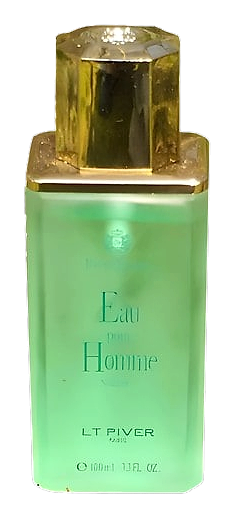
Eau pour Homme arrived in 1995 from L.T. Piver, a French house with roots reaching back to 1774 and a relationship with French haute perfumery that stretches across centuries. The label itself carries the phrasing "French Haute Perfumery since 1774," positioning the house among the oldest names to have survived the long arc of Parisian perfume history, more than two hundred years of bottles, formulations, and changing tastes. By the time this composition entered the catalogue, the house had accumulated a quiet kind of authority: archival rather than loud, refined through generations rather than chasing them. Eau pour Homme takes its place within that archive, a woody-fougère announced on the source listing with freshness, spices, and a citrus note as its opening pillar.
What makes this composition distinctive is how clearly it stays itself within a category known for density. The woody-fougère archetype often piles on darkness, weight, sweet resins, smoky undertones. This one refuses that pull. The citrus lead keeps the top transparent and almost weightless, a thin bright layer that does not commit to heaviness. Once that lift settles, the aromatic and green accords take over without deepening into anything sticky or dense.
The evolution
The opening announces itself almost immediately, a citrus brightness that carries with it a fresh-spicy green sharpness, the kind of clean-cut first impression that signals a classic eau de cologne inheritance without nostalgia or sentimentality. The aromatic and green accords take hold quickly once the citrus flash recedes, letting the middle phase read as a composed, herbal, cool-toned center that grounds the composition. This is where it seems most itself, holding steady without shifting dramatically, a long quiet stretch where the fresh-spicy character remains the dominant voice. As the composition wears, the woods and the softer base notes start to surface, warming the drydown without ever pushing it into territory that feels heavy or overtly sweet.
Cultural impact
Eau pour Homme sits within the 1990s fougère tradition, a category with roots deep enough that any new entrant reads as a continuation rather than an invention. The composition draws on a recognizable vocabulary: citrus, fresh-spicy aromatics, woods. That combination speaks to a wearer who already knows what a proper fougère smells like and appreciates that older dialect preserved without dilution. The accord structure lists citrus, aromatic, green, fresh-spicy, woody, and synthetic as its main threads, a lineup more interested in clarity than spectacle. The cultural weight here is quiet.