The Story
Why it exists.
The beginning
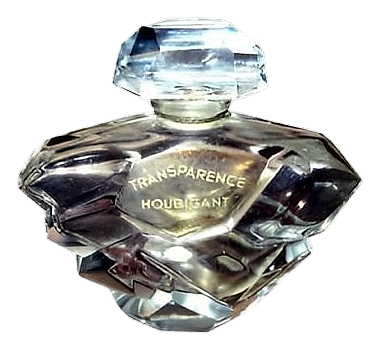
Transparence arrived in 1939. Houbigant released a composition that quietly staked a claim no bottle had quite managed before: the first modern floral fragrance. Before Transparence, florals tended to arrive in the language of soliflores or classical bouquets, dense little arrangements that smelled like a florist's window or a Victorian still life. This one opened with aldehydes, a synthetic sparkle that turned the whole genre inside out and let the light in. The name says it plainly. Transparency as a value, a technique, a mood. Nothing hidden under layers of moss or amber weight. Just the flower, the air around it, and the skin beneath.
What made the composition radical was a philosophical choice. Aldehydes had appeared in earlier fragrances, lending certain compositions their icy shimmer. Houbigant's move was to let those synthetic top notes speak first, then hand off directly to a clean floral heart of jasmine and rose. The aldehydes functioned as the opening statement here, and the rest of the fragrance was arranged beneath them. Rather than hiding them inside a thick base or burying them under resin, the composition gave them the spotlight and asked the floral heart to perform in plain sight.
The evolution
On skin, Transparence announces itself within the first ten minutes. The aldehydes arrive bright, almost metallic, like sunlight off a windowpane or the cold side of a polished mirror. There's a soapy, clean-laundry quality to it that doesn't apologize. Then something unexpected happens around the thirty-minute mark. The sharpness doesn't vanish. It thins, stretches, becomes a kind of luminous backdrop for the jasmine and rose to step forward into. The florals don't bloom so much as settle, calm and slightly powdery, with jasmine leading and the rose tucked behind it like a quieter sister. The aldehyde glow persists as a kind of atmospheric haze, the olfactory equivalent of light filtered through sheer curtains. By hour two, the composition has shifted decisively. The aldehydes are a memory now, and the base begins its work. Vanilla arrives soft and creamy, not gourmand.
Cultural impact
Transparence is credited as one of the first modern floral fragrances, a composition that arrived at a moment when the conventions of the genre were ready to be questioned. By placing synthetic aldehydes at the front of the structure and refusing to bury them under layers of moss, amber, or chypre architecture, the fragrance offered something genuinely new. It belongs to a quiet lineage of pre-war releases that introduced materials and structures that the rest of the industry would spend decades trying to understand, imitate, and argue about.