
The Story
Why it exists.
The beginning
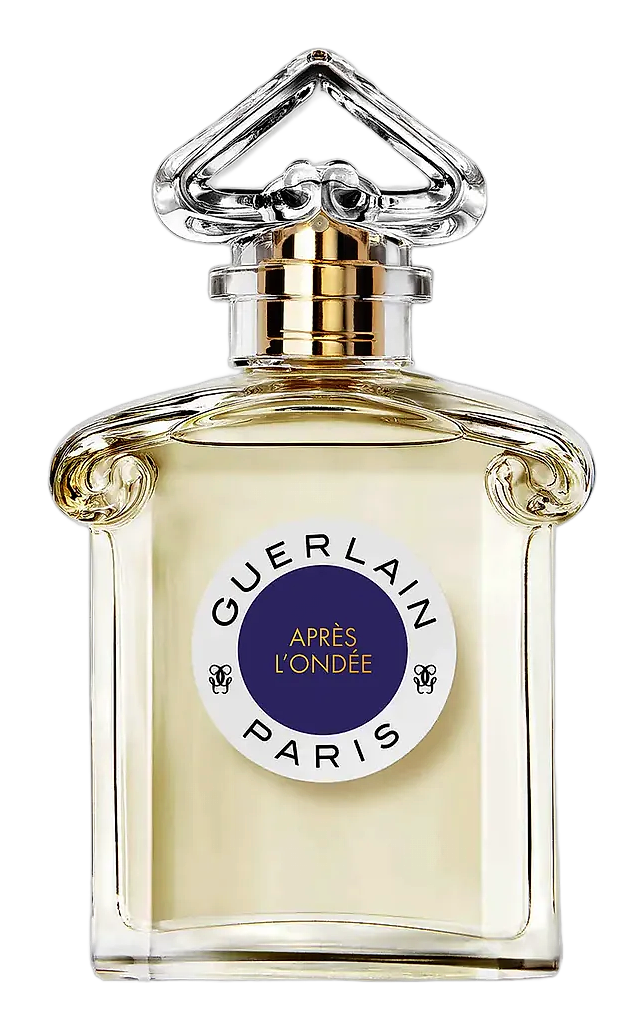
Après L'Ondée was born in 1906 under the hand of Jacques Guerlain. The name means "after the shower". It was inspired by Origan, a Guerlain composition that had made p-anisaldehyde famous in perfumery, a synthetic material with a sweet, warm smell that resembles mimosa and hawthorn blossom. Jacques created this fragrance to capture something distinct from his previous work, exploring the scent of the air after rainfall rather than the flowers themselves. The result is a fragrance that evokes that quiet, refreshed atmosphere.
What makes this eau de toilette distinctive is how it opens. Anise leads, green and faintly liquorice-cool, a note most florals would never dare place first. Cassis trails it with a tart blackcurrant snap that keeps the start bright rather than sweet. That mineral, almost analytical entry is the whole trick: it clears the air so the powder can arrive without turning cloying. The heart answers softly, violet blurring into carnation's quiet spice, and then iris drops the temperature again with its dry, root-like hush. Vanilla waits underneath the whole time, warm but never loud, which is why the composition reads as the air after rain rather than a bouquet.
The evolution
The opening presents green, herbaceous notes, sharp and aromatic, before citrus brightness arrives to illuminate them. The blackcurrant note brings tartness, cutting through with a luminous quality. As the fragrance develops, violet emerges with its soft, powdery character. Carnation contributes a subtle spice that reveals itself gradually. Iris grounds the heart with its characteristic dusty quality that amplifies everything around it. As time passes, vanilla surfaces, warm and intimate, never projecting loudly. The drydown reveals powdery iris softening into vanilla's gentle warmth, intimate enough to be noticed only at close range.
Cultural impact
Guerlain's Les Légendaires collection houses the house's most storied creations, and Après L'Ondée has earned its place there. Since 2014, a bottle has rested in the Hall of Mirrors at Guerlain's Paris headquarters, a testament to its status within the house. Jean Claude Ellena has cited the fragrance as inspiration for his own work, specifically mentioning it as a touchstone for L'Eau d'Hiver. The 2021 reissue makes this piece of perfumery history accessible to a new generation.
The House
GuerlainGuerlain stands as one of the oldest and most revered perfume houses in the world, founded in Paris in 1828 by Pierre-François-Pascal Guerlain. What began as a boutique on rue de Rivoli quickly became the preferred destination for Parisian society, attracting dandies and elegant women who sought custom-crafted fragrances. The house's influence grew to such heights that Guerlain earned the title of Official Perfumer to Napoleon III after presenting Eau de Cologne Impériale to Empress Eugénie as a wedding gift in 1853. This royal patronage marked the beginning of Guerlain's enduring association with European aristocracy, as the house went on to create fragrances for Queen Victoria and Queen Isabella II of Spain. Today, under the creative direction of Thierry Wasser, the fifth-generation perfumer, Guerlain continues to shape the landscape of fine fragrance with a portfolio spanning over 1,100 olfactory creations. The house remains headquartered at its legendary Champs-Élysées mansion, a historic monument that anchors Guerlain's position at the intersection of heritage and contemporary luxury.
The Creator
Jacques GuerlainJacques was among the first perfumers to work seriously with synthetic ingredients alongside naturals, publishing on essential oils with chemist Justin Dupont and experimenting with perfuming ink. His technical approach was precise: volume measurements for liquids, careful wei…