The Story
Why it exists.
The beginning
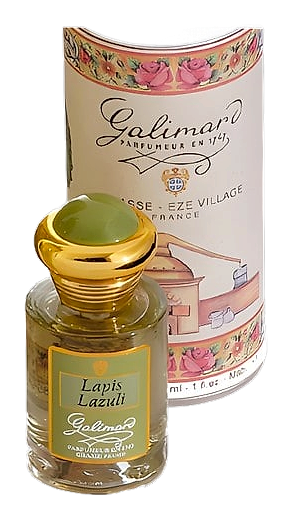
Galimard approaches fragrance the way some people approach photo albums, as living proof that moments matter. Lapis Lazuli came from that conviction: a scent meant to feel precious, intimate, and lasting, built on memory rather than trend. The name carries weight. Lapis lazuli is among the oldest gemstones in human use, prized across centuries for its deep blue color and flecks of gold pyrite that catch light like scattered stars. Rather than replicating the stone's look, Galimard translated its spirit, that tension between mineral depth and luminous warmth, into something wearable. The cool blue of violets against golden peach brightness. Powdery florals softened by warm woods. A fragrance that feels both precious and personal, rooted in the house's belief that scent should be an archive, not a distraction. Lapis Lazuli exists as a testament to the slower craft, the kind of perfume that asks something of you, then rewards you for giving it.
The violet-peach pairing is the quiet achievement here. Violet carries a natural powderiness, almost aldehydic in its dryness, it can veer into dusty territory if not balanced with care. The peach keeps it from feeling dated, adding a sweetness that breathes without becoming loud. Ylang-ylang and jasmine deepen the floral heart without pushing into indolic territory. The restraint matters. This is not a fragrance trying to announce itself. The base is where Galimard's craft shows. Sandalwood and tonka bean do not merely support, they transform. The combination adds a warmth that reads almost talc-like in its softness, giving the drydown a powdery finish that lingers close to the skin.
The evolution
The opening arrives in soft fruit, peach and raspberry, bright and immediate, without the sharp edge that some top notes carry. It reads fresh, not sweet. The raspberry especially adds a tartness that keeps things grounded for the first thirty minutes or so, a brief burst of brightness before the heart takes over. Then the florals arrive. Violet leads, carrying that signature powdery dryness that gives Lapis Lazuli its unmistakable character. Jasmine and ylang-ylang move in underneath, warm, slightly sweet, but kept in check. The handoff from fruit to floral is seamless. No awkward gap, no jarring shift. The aldehydic quality of the violet becomes more pronounced as the minutes pass, settling into a classic floral heart that feels pulled from a different era, refined, composed, old-world in the best sense. The drydown is warm and close. Sandalwood and tonka bean ground the florals with a creamy softness, vanilla adding a sweetness that never quite announces itself but is impossible to miss.
Cultural impact
Lapis Lazuli was discontinued, which tells its own story. It arrived at a moment when the market was moving toward safer, sweeter fruity florals, the kind that perform immediately and fade politely. Lapis Lazuli did not fit that mold. Its aldehydic violet character carried an old-world refinement that required patience, and its moderate sillage meant it lived close to the skin rather than announcing itself across a room. Those qualities made it divisive. Wearers either found it surprisingly elegant, a classical floral with genuine depth, or too close to the aldehydic 'old lady' category that had fallen out of fashion. The community reviews reflect that split.