
The Story
Why it exists.
The beginning
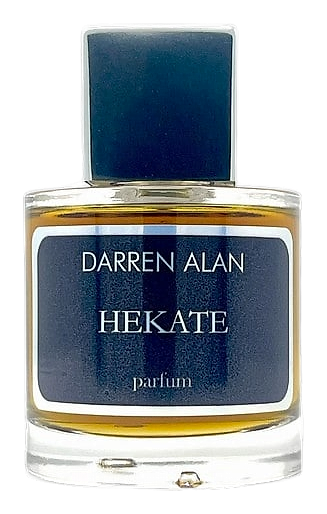
The goddess of night. Crossroads. Magic at the threshold between one world and the next. Hekate has been called the most mysterious figure in the Greek pantheon, she who waits at the crossroads, torch-bearing, unseen. Darren Alan named this fragrance for that darkness. Not the darkness of horror, but the darkness of depth. The kind of space that exists between dusk and the moment you can't see anymore. This is a fragrance built from autumnal materials: fir balsam, dried fruit, the warmth of mulled spices. It draws on the fragrant logic of a season ending, when resinous wood burns, when honey thickens, when the air carries something older than the year itself. Hekate invokes that shift. Not a summer scent. Not a safe one.
The base is where Hekate earns its name. Cambodian oud, myrrh, castoreum, sandalwood, benzoin, orris root, these aren't decorative elements. They're structural. They hold the entire composition together across hours, slowly releasing and recombining as the fragrance warms against skin. What makes this unusual is the beeswax absolute and honey in the heart. Both are sweet materials that could easily tip a fragrance into something simple and linear. Here, the beeswax acts almost like a binding agent, it doesn't just add sweetness, it smooths the transitions between the spicier opening and the darker base. The result is a fragrance that doesn't announce itself and then fade. It unfolds. Repeatedly.
The evolution
The opening hits with fir balsam, sharp, almost coniferous coldness. Beneath it, dried apricot arrives with a fruity, slightly tart sweetness that tempers the sharpness. Mulling spices add warmth without heat. This phase lasts maybe thirty minutes before the fir softens and the honey begins to surface. In the heart, beeswax and cedar take over. The beeswax doesn't smell waxy exactly, it smells like something warm and golden, slightly animalic in its sweetness. Cedarwood brings structure. Cypress adds a faint evergreen lift. Patchouli roots everything in earth. The honey in this phase is notable: sweet but not cloying, more amber than confection. The drydown is where Hekate diverges from what the opening promised. The castoreum emerges slowly, bringing a leather-and-skin quality that reads almost as smoky. Cambodian oud adds depth without any harshness. Benzoin and myrrh provide a resinous warmth that can persist for hours, reports indicate the fragrance holds for 8 to 10 hours on most skin. The final impression is warm, dark, and intimate.
Cultural impact
Hekate occupies a specific corner of the indie fragrance landscape: dark, resinous, unapologetically complex. It draws on the logic of autumn, not the curated, candle-moment version of autumn, but the actual season's darkness and depth. The fragrance has drawn comparisons to Areej Le Dore in its use of animalics and dense base materials, and to the dried-fruit opening of Georgian perfumery. For wearers who want something that takes hours to fully reveal itself, Hekate rewards that patience. The animalic notes, particularly the castoreum, are handled with restraint, appearing as depth rather than shock. This is not a fragrance that tries to please everyone.