The Story
Why it exists.
The beginning
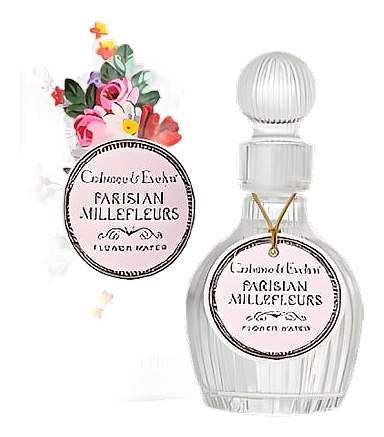
Parisian Millefleurs arrived in 2015 as an homage to Crabtree & Evelyn's original Millefleurs, which drew its inspiration from the opulent floral style of 18th century French perfumery. The name itself says it all, mille fleurs, a thousand flowers. But this isn't a garden explosion. It's something more considered. The original Millefleurs had quietly built a following among those who appreciated its unhurried approach to florals, and this new interpretation carried that spirit forward into a new decade.
What makes Parisian Millefleurs unusual is its subtle use of French botanicals at key moments. The top opens with French juniper and French pink pepper, a cool, aromatic pairing that immediately reads as French in the same way a brasserie reads as French. Green notes and lychee soften the entry, but never fully displace that crisp, almost herbal quality. The heart is where the florals bloom in earnest: French narcissus brings a strange, hypnotic warmth; rose and tuberose layer in classic yellow-floral richness.
The evolution
The opening announces itself clearly: juniper's cool, aromatic bite alongside pink pepper's subtle spice. This is a green start, sharp enough to catch attention but already restrained, already polite. Green notes and lychee smooth the transition, adding a faint sweetness that prevents the entry from feeling austere. The hand-off to the heart takes twenty minutes or so, and what arrives is not a single floral but a layering of them. Narcissus carries the unusual quality here, slightly narcotic, warm, almost honeyed. Rose and tuberose follow, building that classic yellow-floral richness. Violet appears mid-heart, adding powdery softness that begins preparing the way for the base. By the time the drydown settles, the florals have retreated but not vanished, they're still there, memory-of-florals rather than florals-themselves.
Cultural impact
Parisian Millefleurs arrived in 2015 as a limited women's fragrance and has since been discontinued. The fragrance never reached wide distribution or significant press coverage, but its 18th-century French perfumery inspiration gave it a distinctive character. Wearers describe it as a powdery, intimate experience, the kind of scent that suggests a specific person and moment rather than announcing itself to a room. It's found a following among those who seek the less-traveled path in fragrance: botanical-forward, restrained, and deliberately unhurried.