The Story
Why it exists.
The beginning
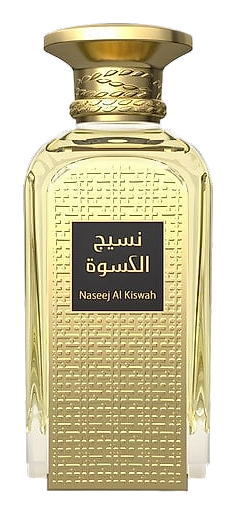
Naseej Al Kiswah arrived in 2021 as part of Afnan's Naseej collection. The name itself carries weight: "Kiswah" refers to the cloth, the covering, a word that points to texture and material rather than any single cultural symbol. This particular entry leans into the amber-woody register that defines some of the brand's bolder compositions, a direction that favors warmth, density, and staying power over the airy constructions that often dominate mainstream perfumery. Naseej Al Kiswah fits that profile almost too neatly. It doesn't reinvent anything. It deepens a formula the house already knows works, and there's a quiet confidence in that choice.
What separates this from a dozen other amber-woody releases is the balance between its anchors. Patchouli opens with that earthy, almost damp quality, but the tonka bean rounds it out before it tips into something purely austere. Cedar in the heart provides structure rather than sparkle, setting up the leather and oud in the base to do the heavier lifting. The interplay is smooth and deliberate, with each material supporting the next rather than competing for attention.
The evolution
The first 30 minutes belong to patchouli and tonka, with patchouli doing the heavy lifting while the tonka softens what could otherwise feel raw. Amber sits underneath, adding a low hum of warmth that holds everything together. By the second hour, cedar arrives and the whole composition tightens up, the sweetness recedes and something drier takes over. Leather shows up around the three-hour mark, giving the scent a slightly smoky, almost tobacco-adjacent edge that wasn't obvious at the start. Oud anchors the base throughout, never loud, always structural. On skin, the full arc runs about 4-6 hours, with the final hours reading as a warm, slightly animalic close that clings to fabric. The next morning, what's left on a sweater collar is mostly leather and amber, quieter, more intimate than what was on skin the night before.
Cultural impact
Naseej Al Kiswah draws its name from the kiswah, a word rooted in Arabic and tied to the idea of woven cloth, covering, and textile craft. That linguistic lineage gives the fragrance an immediate sense of material richness before a single note is smelled. The composition leans into that association by centering texture: the dense weave of patchouli, the structural grain of cedar, the supple weight of leather, and the deep resinous folds of oud in the base. Amber resins and musk notes, both common anchors in Arabian perfumery, lend the scent its particular warmth and longevity on skin.