Phantom Orchid Scenttrek
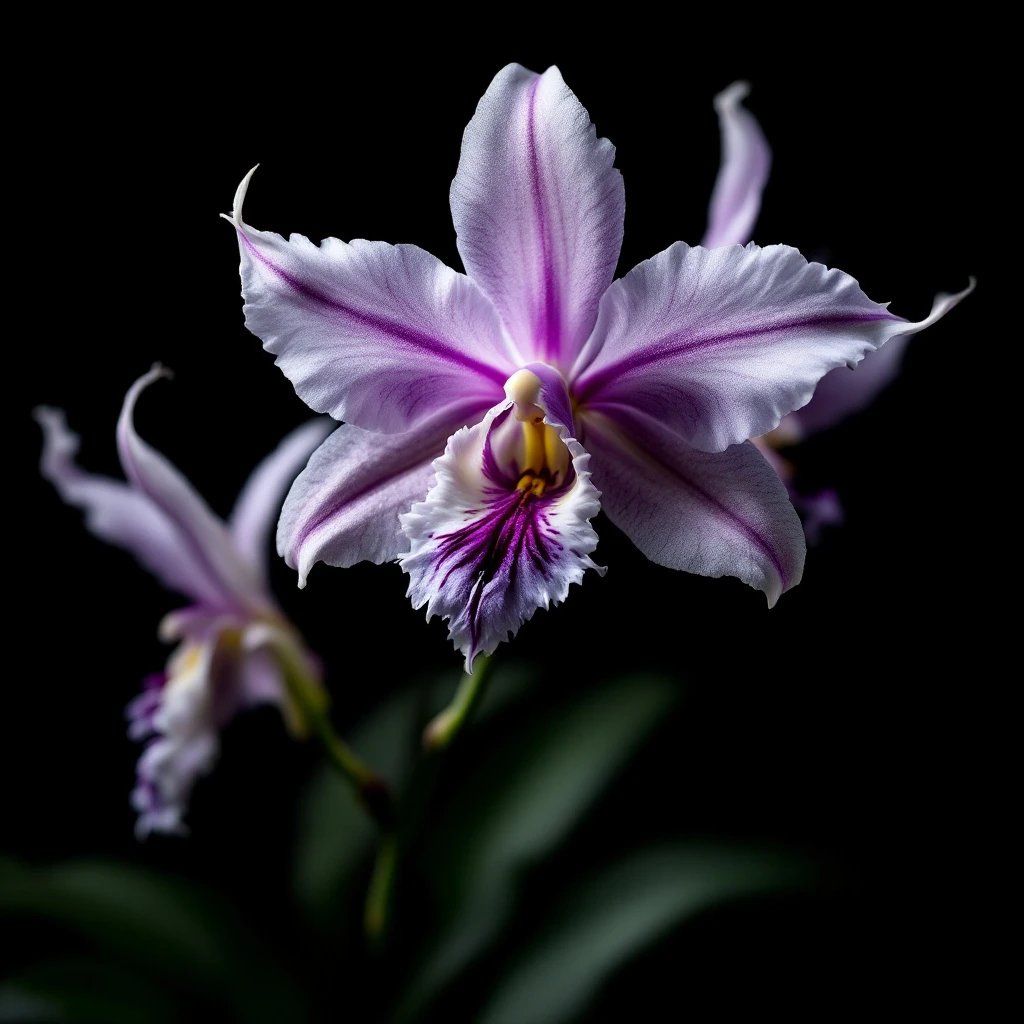
Phantom Orchid Scentrek captures the molecular ghost of a flower too rare to harvest, translating its elusive dusk-release fragrance into a working perfumery ingredient.
Character
How it smells
A ghost flower, captured by science.
Real orchids release perfume only after sunset to attract specific nocturnal pollinators, making daytime sampling useless.




Origin
United States
The word orchid derives from the Greek orchis, but the common name for the broader family traces back to a different root entirely, one meaning testicle, a reference to the tuber's shape noted by ancient herbalists. The actual fragrance of orchids entered European awareness slowly. collectors in the 18th and 19th centuries prized orchids for visual rarity, while their scents, often released at night to attract moths, went largely undocumented.
Grasse, the historic French perfume capital, built its industry on enfleurage and later solvent extraction, both of which require abundant raw material. Orchids rarely cooperate with that model. The breakthrough came in the late 20th century when Givaudan developed headspace technology, originally designed for environmental monitoring, and adapted it for perfumery.
The Scentrek program sends perfumers worldwide, from Florida's Fruit and Spice Park to Givaudan's own school gardens, to trap scent molecules directly from living specimens. For the Phantom Orchid, a white, seldom-seen North American species, this approach remains the only commercially viable way to bring its character into a bottle without harvesting protected plants. Scentrek thus represents a shift in perfumery's relationship with biodiversity, from extraction to observation.
Wears it best
Fragrances featuring Phantom Orchid Scenttrek
Brands
Brands known for Phantom Orchid Scenttrek
Good to know
Questions, answered
The essentials on Phantom Orchid Scenttrek in perfumery: how it smells, where it comes from, and how it behaves on skin.
What does Phantom Orchid Scentrek smell like?
It carries a soft, green floral character with honeyed undertones and faint leafy freshness, mirroring the scent the living flower releases after dark. The accord remains subtle rather than indolic, shaped by the plant's nocturnal pollination strategy.
Is Phantom Orchid Scentrek natural or synthetic?
It is a reconstructed accord. The original scent molecules were captured from a living orchid via headspace technology, then rebuilt in the lab using a combination of isolated natural compounds and identical synthetic aromachemicals.
Why can't Phantom Orchid be distilled like other flowers?
Distilling orchids at scale is impractical and ecologically damaging. The Phantom Orchid is a protected, sparsely distributed species, so perfumers rely on headspace capture from a single living bloom instead of harvesting biomass.
When does the Phantom Orchid release its scent?
Dusk or after dark. The plant is pollinated by nocturnal insects, and its fragrance compounds volatilize once sunlight fades, which is why field capture must occur in evening hours.
Where is the Phantom Orchid native to?
It grows across western North America, particularly in mixed conifer forests of California, Oregon, and Washington, usually in shaded, mycorrhizal-rich soils.
Who developed Scentrek technology?
Givaudan developed Scentrek, and the company operates ongoing perfumer field expeditions, including captures at its own perfumery school gardens and at Florida's Fruit and Spice Park.
Is the Phantom Orchid endangered?
Populations are sparse and declining due to habitat loss, which is a key reason the species is protected and why non-destructive capture methods are the only ethical option for perfumery.
Can Phantom Orchid Scentrek be used in fine fragrance?
Yes, the reconstructed accord functions as a top-to-heart note in fine fragrance compositions, valued for its unusual green-floral softness and the novelty of a scent sourced without harvesting the plant.



