The Story
Why it exists.
The beginning
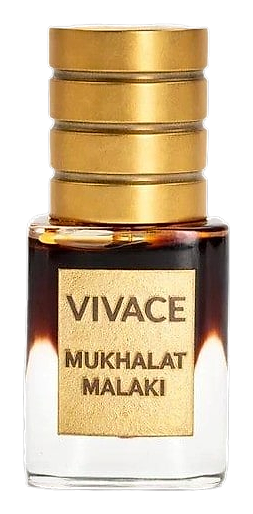
Released in 2026 by Vivace Perfumes, Mukhalat Malaki draws from carefully selected materials drawn from the brand's private collection. The composition, credited to Muhammad Islamov, positions frankincense as the opening note, with florals and oud occupying the heart, and amber, musk, saffron, and spices anchoring the base. This pyramid structure gives the fragrance a clear architectural logic, with each tier doing specific work rather than competing for attention. The result reads as a study in how far material selection can carry a composition when the underlying formula stays disciplined.
The accord structure of Mukhalat Malaki stacks white floral, oud, and animalic elements directly atop one another, creating vertical layering rather than horizontal spread. The frankincense opens with notable clarity, a resinous note that establishes the composition's tonal center before the heart notes begin to surface. Saffron and spice sit in the base alongside amber and musk, contributing warmth and depth without overwhelming the central accord. Reading the pyramid carefully reveals the logic of the whole: a fragrance that knows which notes belong where and refuses to let them wander.
The evolution
The opening belongs to frankincense, rendered here with a sharpness that catches you off guard if you're expecting something heavier. There's a resinous clarity to the first minutes, an almost bright character that gives the composition lift before the warmer elements arrive. Underneath, the florals begin to surface gradually, and the oud accumulates rather than announces itself, building presence without ever feeling aggressive. As the hours pass, the composition reorganizes around the heart notes: the frankincense recedes, the oud takes a more central position, and the amber starts binding the whole structure together. The fragrance grows quieter, more skin-like, settling into a warmer register that trades the opening's clarity for closer intimacy.
Cultural impact
Mukhalat Malaki offers an interesting case study in how contemporary Arabian perfumery continues to refine its approach to traditional materials. The fragrance keeps the core structural elements of oud, frankincense, amber, saffron, and spice while applying a noticeably disciplined hand to how those notes interact. Where some compositions in the oud-forward space pile on material after material, this one strips back, favoring material restraint and a more controlled wear. The result is a composition that favors material clarity and skin-close performance over the heavier projections that characterize many modern oud releases.