
The Story
Why it exists.
The beginning
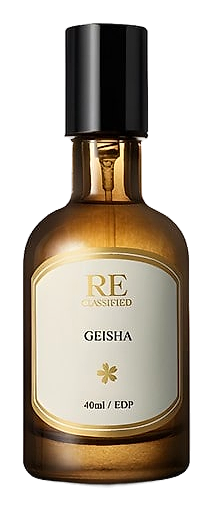
Geisha 祗园花魁 arrived in 2014 from RECLASSIFIED RE调香室, a fragrance house whose catalogue has steadily grown around conceptual, narrative-driven scent. The fragrance takes its name from the geisha, the Japanese entertainers whose art encompasses music, dance, tea ceremony, and conversation, refined companions rather than the courtesans popular imagination often assumes. The composition translates that duality into scent: something ornate and composed on the surface, something private beneath. The cherry note appears twice, once in the heart alongside peony and again in the base as a deeper extract, an unusual structural decision that bookends the composition with the same fruit at two different intensities.
What makes Geisha worth noticing is its cherry-led structure. Most cherry-dominant fragrances lean either syrupy-sweet or medicinal-almond. Here, cherry appears twice, in the heart alongside peony and again in the base as a deeper extract, bookending the composition with the same fruit at two different intensities. The addition of bay leaf and warm spice at the top introduces a green, slightly herbal edge that keeps the opening from feeling like confectionery, lending the first hour a faintly aromatic, almost incense-like quality that recalls temple air more than pastry.
The evolution
The opening is a burst of raspberry tartness cut by bay leaf's green bite, with rose underneath adding a faint dusty warmth. It reads bright, almost sparkling, for the first fifteen minutes. Then the heart settles: cherry comes forward, sweet but not candied, riding alongside peony's soft, slightly powdery floralcy. The transition into base is where Geisha shifts register. Cherry extract deepens, taking on an almost boozy, stewed-fruit quality, while palisander rosewood and mahogany introduce a furniture-warm, slightly resinous woodiness. The drydown is warm, polished, intimate. On fabric the cherry can linger for over a day, faded but present. On skin the wood softens into something close to warm skin itself, the fruit retreating until only the timber remains.
Cultural impact
Geisha Gion Oiran arrived in 2014, and the title layers two references: the Japanese geisha tradition of measured, ritual beauty, and Gion, a term drawn from the cultural vocabulary surrounding that tradition. By choosing a name rooted in Japanese iconography, the brand enters a long conversation about beauty, restraint, and performance that the geisha archetype embodies. The fragrance itself treats cherry, rosewood, and mahogany as more than raw materials, building them into a portrait of composure layered over something warmer and more private.