
The Story
Why it exists.
The beginning
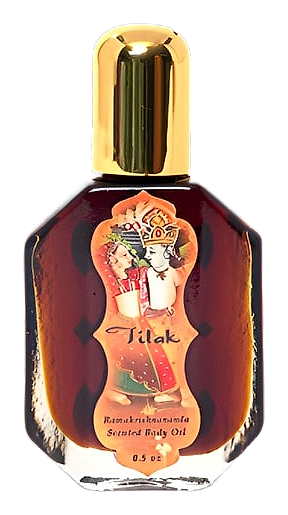
Tilak takes its name from the sacred mark worn on the forehead, the colored dot placed there during worship. The name reaches further than the dot, though. Tilak also refers to the holy dust of the Yamuna River, the place where Krishna's pastimes unfolded, and the fragrance is named for that dust as much as for the mark. Ramakrishnananda, an Indian devotional house, builds its attar line with this kind of deliberate naming. Padma for lotus. Atma for soul. Prema for love. Tilak belongs to that catalog, a scent intended as offering rather than accessory. The bottle sits somewhere between tradition and accessibility, an attar you can find through ordinary retail channels even though its roots reach back into something older and more devotional than most modern perfumery.
What makes Tilak interesting is how little it tries to do. Three notes: orange blossom, vanilla, honey. That's the complete list. No woods anchoring the base, no musk giving it structure, no resin to deepen the edges. It's a composition that refuses to build a fortress around itself. The accords tag it as white floral and vanilla up front, with sweet and honey threaded through, but the tags also note powdery, soapy, and animalic notes that complicate the picture. The animalic element is the surprise.
The evolution
The opening belongs entirely to orange blossom, and not the polite, distant version. This one has body, almost a soapiness to it, the way white florals can read when they're not filtered through a lighter cologne structure. The honey arrives quickly, threading through the orange blossom like syrup dissolving in warm water, and the two merge into something that smells less like a fragrance and more like a moment you want to stay inside. The vanilla surfaces as the composition softens, and this is where Tilak shifts register. The sharpness of the opening rounds out. The floral recedes. What replaces it is a round, almost edible warmth, the kind of vanilla that reads more like skin than like a dessert. The animalic accord makes itself known in this later phase, not as anything overt but as a closeness, a warmth that seems to come from the wearer rather than the bottle.
Cultural impact
Tilak sits in an unusual niche: it's an attar oil, a devotional product first, sold through retail channels that put it in conversation with mainstream fragrances while drawing on a much older perfumery tradition. Wearers respond to it, and the vanilla-honey-orange blossom triad gives it a sweetness that places it within the broader sweet-floral category, though Tilak's structure is far leaner than most of its neighbors. There's a quiet confidence to the composition, a refusal to layer on the usual anchoring notes, and that minimalism is part of what makes it distinctive.