
The Story
Why it exists.
The beginning
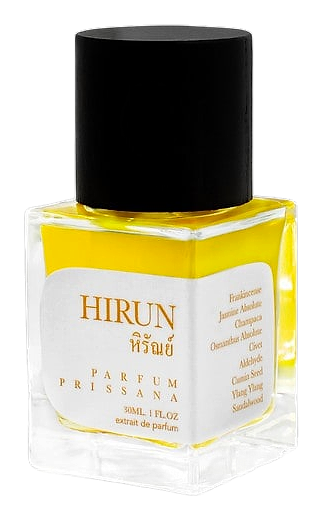
The name announces the intention before you smell a single note. Hirun, 'gold' in Thai, is Prissana's nod to opulence, to richness without apology. But the real statement is what follows: a fragrance built in the image of a lost era. The golden age of aldehyde base perfumes, when compositions dared to be large, complex, and unapologetically themselves. When perfumes announced a presence rather than whispered one. Prin Lomros doesn't hide the reference. The aldehydic lift that opens Hirun, bright, metallic, almost cold, is a direct line to those mid-century compositions that defined what luxury smelled like. Myrrh and rose arrive next, the classic pairing, warm and resinous. But this isn't a museum piece. It's a living conversation between a 2024 nose and the ghosts of perfumery's most ambitious decade.
What makes Hirun unusual is its commitment to the aldehydic genre in an era when complexity has fallen out of fashion. Modern releases tend toward transparency, linearity, the 'skin but better' ideal. Hirun goes the other direction. The aldehydes don't just introduce, they transform. They lift the rose into something more aerial, brighten the myrrh into something almost metallic, give the civet a warm animalic glow rather than a barnyard sharpness. The result is vintage in structure but contemporary in execution. Each material earns its place. Nothing is added for novelty. The orris root and osmanthus absolute add a powdery sweetness that balances the animalic notes.
The evolution
The aldehydes announce themselves immediately, bright, waxy, a little cold. Like cold cream on warm skin, some wearers say. Others hear 'champagne bubble' or 'scented candle first strike.' Either way, the opening is commanding and assured. The citrus, lemon, neroli, threads through, keeping things fresh and sharp even as the aldehydes dominate. The rose arrives quietly, almost mid-bloom rather than opening. Paired with myrrh from the start, it creates a warm heart that begins to push back against the aldehydic brightness. Jasmine and orris join the conversation, their powdery florality weaving through the composition. The aldehydic lift never fully disappears, but it transforms, becomes a shimmer beneath the florals rather than their master. As the fragrance develops, civet and cumin add an animalic warmth that makes the florals feel intimate rather than public.
Cultural impact
Hirun enters a landscape where vintage aldehyde compositions have become increasingly rare. While most modern releases favor transparency and linearity, Hirun commits to complexity, baroque structure, and an unapologetic presence. The aldehydic genre carries a particular weight in fragrance appreciation, demanding attention and rewarding study. Hirun offers a statement piece for those who want their fragrance to mean something beyond pleasant, inviting wearers into a world of intricate layering and historical resonance.