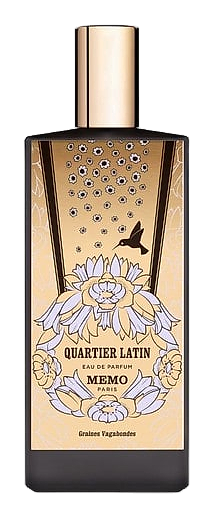

The Story
Why it exists.
The beginning
The Latin Quarter didn't become Paris's literary heart by accident. Its character grew the way all real things grow: slowly, in coffee shops and secondhand bookshops, in late nights and early mornings, in the particular quality of light that only slants through old zinc rooftops. Aliénor Massenet built Quartier Latin around this energy, the bohemian undercurrent that runs beneath the Sorbonne's ancient stones, the way jazz and poetry have always bled into each other on those narrow streets. Tonka bean and amber anchor the composition in warmth. Everything else, the spice, the flowers, the wood, simply extends the invitation to stay.
What makes this composition hold together is the tension between its sweet and its sharp. Cardamom and clove arrive together, a bracing opener that could tip into harshness if the tonka and peach weren't there to soften. They are. And then jasmine, rose, and violet arrive like a page turned in a book you've been reading for hours, familiar, but somehow better than you remembered. The violet is the real trick. Powdery and intimate, it could easily disappear in a woody-amber base. Here, it doesn't. It threads through, cool against the warmth, making the whole thing feel inhabited rather than heavy.
The evolution
The opening is immediate. Cardamom and clove hit first, aromatic and almost medicinal before the peach rounds the edges. Thirty minutes in, the florals arrive, jasmine first, then rose settling beside it, violet lifting through like a memory you can't quite place. The heart is where this fragrance earns its name. Powdery, intimate, like the inside of a bookshop on a rainy afternoon. The base takes over around the two-hour mark and it doesn't rush. Australian sandalwood and cedar arrive together, dry and resinous, commanding the composition. The amber and tonka bean do their work underneath, sweet, warm, slowly building into something that smells less like fragrance and more like skin that happens to smell good. By hour six, the tonka's coumarin note emerges: hay, tobacco, the faintest suggestion of chocolate. It stays close. A whisper, not a shout. On fabric, it lingers until the next wash.
Cultural impact
The Latin Quarter has long been synonymous with intellectual freedom, bohemian spirit, and the quiet rebellion of ideas. Quartier Latin the fragrance captures this ethos through its warm, powdery character, translating the neighborhood's scholarly history into something wearable. The 2012 launch reflects a broader trend in niche perfumery: the desire to bottle place-based memories rather than generic luxury. Memo Paris treats each fragrance as a sensory postcard, and this one succeeds by balancing the spice of cardamom and clove with the softness of violet and tonka, creating a scent that feels both lived-in and romantic. Its cultural resonance lies in the nostalgia it evokes, the sense of a Paris that exists more in memory than in maps.