The Story
Why it exists.
The beginning
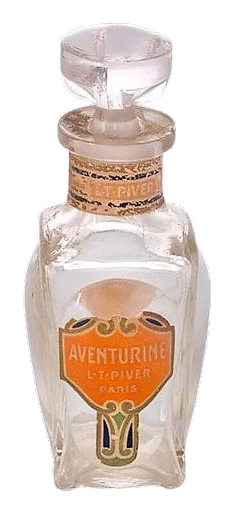
Aventurine arrived in 1913 from L.T. Piver, a French house established in 1774 and considered one of the oldest perfume houses in France. The name suggests the mineral aventurine, a stone with coppery flecks suspended in greenish translucence, and the composition seems to reach for something similar: a surface that seems still and quiet on first glance, but holds depth you only notice once you're close enough to lean in. The scent was reportedly discontinued, which places it firmly in collector territory rather than current retail. What makes Aventurine worth attention is the way it bridges a particular moment in French perfumery, that turn-of-the-century taste for compositions that read as powdery and soft from a distance but reveal themselves in layers as you draw closer.
What's striking about a 1913 L.T. Piver composition is how the house treated florals less as decoration and more as architecture. The era favoured dense, structured bouquets that unfolded gradually, and that approach produces compositions of unusual precision. Aventurine reads as powdery and soft from arm's length, but the individual materials are doing specific work: nothing is incidental, nothing is filler. Each layer serves the one above and below it, creating a vertical structure that holds its form rather than dissolving into diffuse sweetness.
The evolution
Aventurine opens with a cool, almost mineral-edged lift, slightly sharp and unmistakably French in its clarity. Within that opening there's a brightness that catches the air before settling, the kind of entry that feels architectural rather than decorative. Within ten minutes that lift softens into a dense floral heart, powdery and rounded, cushioned in a way that reads luxurious without ever feeling heavy. The heart phase is where the composition shows its discipline: florals blend into a single texture rather than separating into recognisable blooms, and the result is something closer to velvet than to a garden. At the thirty-minute mark a vanillic warmth begins to surface underneath the powder, lending a soft sweetness that keeps the florals from feeling cold or austere. The warmth doesn't announce itself so much as creep in, the way ambient heat builds in a room after sunset.
Cultural impact
Aventurine holds an interesting position within L.T. Piver's broader catalogue, a 1913 composition from a house established in 1774. Its reportedly discontinued status places it outside the house's current commercial output, which shifts how the fragrance circulates among those who encounter it. Rather than appearing in standard retail channels, Aventurine tends to surface through secondary avenues: collectors who specialise in archival French perfumery, antique perfume enthusiasts tracking down bottles from earlier decades, or auction listings where vintage French fragrances occasionally appear.