
The Story
Why it exists.
The beginning
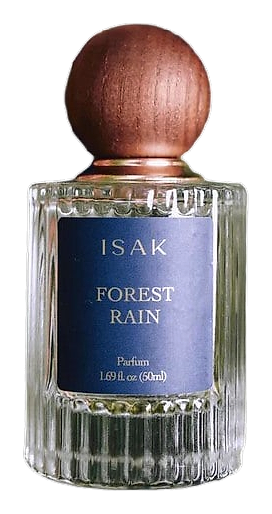
Forest Rain is the kind of concept that sounds simple until you try to bottle it. Rain meeting earth isn't a scent most people can name, but everyone recognizes it. That mineral, ozone-laced moment when the first drops hit dry soil and the whole forest exhales. ISAK took that sensation and built around it, layering petrichor with lilac and lemon at the top, then settling the whole thing into vanilla, amber, cedarwood, and musk. The result is a fragrance that smells less like a perfume and more like a memory of stepping outside after a storm. The composition has a softness that's hard to fake, the kind that arrives without effort. Each note opens in sequence, building toward something quieter and more grounded.
Petrichor is a tricky material. Synthesize it wrong and you get something that smells like a tire or a rubber mat. Get it right and it's atmospheric, almost geological. ISAK pairs it with lilac, which is an unusual move. Lilac is fleeting in nature, and reproducing it in fragrance requires careful balancing. Here it adds a powdery, floral softness that keeps the mineral notes from feeling cold or sterile. The heart of vanilla and amber does the opposite work, warming the composition without tipping it gourmand. Cedarwood and musk in the base ground everything without going woody-heavy. The interplay between wet stone and warm skin is what makes Forest Rain feel like more than its individual parts.
The evolution
The opening is almost disorienting if you're not expecting it. Lemon cuts bright and clean, then petrichor rolls in underneath, and the whole thing reads cool and slightly metallic, like standing at the edge of a puddle. Lilac arrives quickly, powdery and soft, rounding off the mineral sharpness. As the fragrance develops, the warmth starts to build. Vanilla and amber take over the center, and the composition shifts from atmospheric to wearable. The petrichor doesn't disappear, but it recedes, becoming a texture rather than a statement. The cedarwood shows up later than you think it will, anchoring everything with a dry, quiet woodiness. Musk settles in last and stays close to skin, leaving a soft, warm, slightly sweet woody impression that feels like it belongs to the wearer rather than the bottle. The way the notes hand off to each other feels choreographed but not mechanical.
Cultural impact
Forest Rain exists at the intersection of atmosphere and wearability, a space that few fragrances occupy comfortably. Petrichor as a named note carries an immediate sense of place, and ISAK builds on that foundation with surprising warmth from lilac and vanilla. The fragrance wears quietly, settling into the skin without demanding attention, and the lilac-vanilla warmth keeps it from feeling cold or overly conceptual. For wearers drawn to mood and place over loud performance, it offers a gentle, grounded alternative. The composition rewards close attention rather than quick evaluation.