The Story
Why it exists.
The beginning
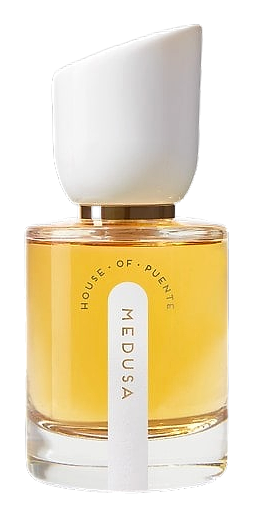
Medusa arrived in 2022 as House of Puente's first fragrance, and the house didn't ease in gently. Named after the myth, it channels the story's central tension: beauty and destruction as the same creature, the same force. Eliam Puente drew from a narrative where transformation is both curse and coronation. The snake-haired queen didn't choose her power; it was given, then taken, then made irreversible. That ambiguity fascinated him. Not a villain origin story. Not a tragedy. Something harder to categorize: the moment power stops asking permission. The name demanded a fragrance that could hold contradictions, luminous florals paired with animalic warmth, the polished next to the primal. Jasmine and rose alongside civet. That combination is unusual precisely because most compositions choose a lane: either the clean floral or the honest animalic. Medusa refused.
What makes the composition work is the orris root acting as a slow-release mechanism. It tempers the jasmine's initial flood, creating a powdery delay that stretches the heart phase longer than expected. Without it, the civet would arrive too soon and the fragrance would read as confrontational rather than beguiling. The orange blossom contributes a tea-like delicacy that most wearers miss entirely, but once pointed out, it becomes impossible to ignore. The result is a chypre structure that behaves like a white floral when observed casually, and an animalic fragrance when examined closely. That's the trick. Most people lean in because the opening is so lovely. Then the civet settles.
The evolution
The jasmine opens like a door thrown wide. Immediate, generous, almost aggressive in its brightness. This phase lasts roughly twenty to thirty minutes before the rose and orange blossom begin their quiet takeover, not replacing the jasmine, but shadowing it, pulling focus inward. The orris root announces itself as powder: soft,Iris-adjacent, the suggestion of face powder applied hours ago. The civet emerges gradually in the heart phase. Not skatole-sharp or barnyard crude. This is the civet that lives close to skin, the kind you only notice when someone leans in. It doesn't dominate, it deepens. The florals become less delicate, more physical. This is the phase where Medusa earns its myth. The drydown belongs to oakmoss and vetiver. Earthy, mossy, slightly bitter. The sandalwood arrives late, adding a creaminess that softens what could have been too severe. On fabric, the drydown outlasts everything else, you'll find this smell in a jacket lining the next morning. Eight to ten hours on skin, strong sillage for the first three. After that, intimate.
Cultural impact
Medusa was voted one of the top 10 fragrances of 2022 on Çafleurebon, a notable recognition for a debut release from a newly founded house. It occupies an unusual position in the niche landscape: a chypre structure built around jasmine and civet, which places it closer to classical perfumery than most contemporary niche releases while maintaining the intimacy and specificity of a personal project. The fragrance attracted collectors interested in animalic compositions but wary of the confrontational nature of heavier examples. Its success established House of Puente's reputation as a house willing to commit to difficult contrasts.