
The Story
Why it exists.
The beginning
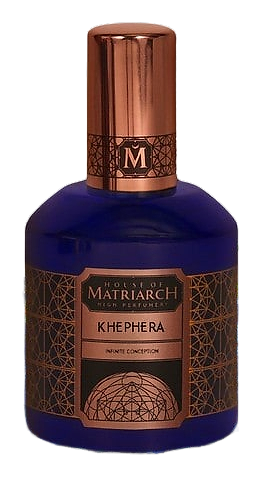
Khephera takes its name from the ancient Egyptian scarab deity, symbol of transformation and morning resurrection, the god who rolled the sun across the sky each dawn. For Christi Meshell, the name was a provocation: can a fragrance carry that weight of renewal without becoming a literal rebirth story? The answer arrived in 2018 as a composition built on tension, smoke against green, ancient symbolism against Pacific Northwest botanical purity, materials that have been burned in ritual for millennia set against something still growing. Meshell has long worked in contrast; Khephera pushed further into territory that felt almost uncomfortable, resinous and smoky, yet threaded with green that refused to let the darkness settle.
The unusual top trio, hemp, coffee, and kencur, is where most fragrances would establish their theme and hold it. Here, they're already in conflict. Coffee brings warmth and a slight bitterness; kencur, a Southeast Asian aromatic root, adds camphoraceous spice; and hemp contributes an herbaceous greenness that's legal, distinct, and unexpected. Together they create an opening that smells less like perfume and more like raw material being processed, earthy, slightly narcotic, grounded. This initial green-dark tension is what makes Khephera unusual: it never fully commits to either side. The smoke arrives, but so does something verdant and alive.
The evolution
The opening is green-dark: hemp, coffee, and kencur create an earthy, herbaceous first impression that surprises with its freshness. It doesn't smell like cannabis recreation, it smells like the plant itself, rooted. This phase lasts longer than expected, holding the tension between raw and refined. Incense and benzoin arrive next, softening the edges. The benzoin brings a sweet balsamic warmth, almost vanillic, that tempers what could have been austere. Incense smoke curls through, but the green doesn't fully retreat, it weaves in and out, keeping the composition from settling into something predictable. Papyrus and gurjun add a papery, smoky dryness. In the drydown, the base notes arrive: hyraceum, an animalic derived from the fossilized urine of rock hyraxes, gives the fragrance a dark, earthy depth that's animalic without being aggressive. Rose appears, but only as warmth within the smoke, not as a floral statement. Musk and the remaining woody-resinous notes settle close to the skin. This is where Khephera earns its name: transformation, but the slow kind.
Cultural impact
Khephera occupies an unusual position in the niche fragrance landscape, resinous and smoky enough to satisfy the incense devotee, but threaded with green freshness that sets it apart from comparable smoky-resinous compositions. The community places it alongside incense-forward niche fragrances from Serge Lutens and similar houses, though Khephera's green hemp and coffee opening gives it a distinct personality. It's the kind of composition that attracts collectors seeking something that doesn't follow the expected template.