
The Story
Why it exists.
The beginning
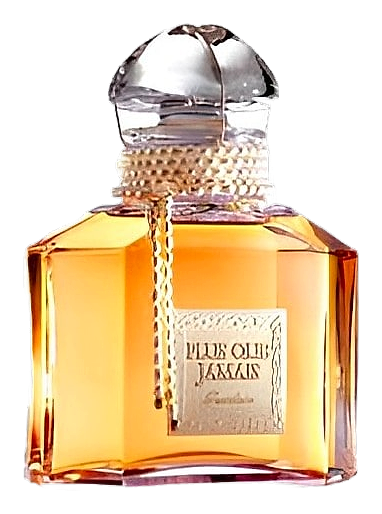
In 2005, La Maison Guerlain reopened on the Champs-Élysées, a landmark moment for a house founded in 1828. For this occasion, Jean-Paul Guerlain returned after years away from the bench. He created Plus Que Jamais, which translates to 'more than ever.' The name is a statement: this is Guerlain at its most Guerlain, not evolved or reimagined but distilled to its essence.
The composition leans fully into the Guerlain signature, aldehydes, powder, iris, vanilla. Ylang-ylang and neroli lift the opening with a waxy, almost sparkling floral quality. The heart pairs jasmine with orris root, giving the powdery iris character room to breathe and deepen. In the base, amber, tonka, and vanilla create warmth while vetiver adds an earthy counterpoint that keeps the sweetness from becoming cloying. This is Guerlain's classic accord, the Guerlinade, showing up without apology or modernization. It's the scent of a house that doesn't need to reinvent itself.
The evolution
The aldehydes arrive first, bright, waxy, lifted. They carry the ylang-ylang and neroli in a sparkling wave that feels almost effervescent. Bergamot threads through, keeping everything polished. Within minutes, the aldehydes begin to settle and the heart takes over. Iris and jasmine emerge together, powdery and warm, with the tonka bean already whispering underneath. This is the Guerlain signature: powder and floral, intimate and refined. The drydown stretches for hours. Amber and vetiver ground the sweetness while vanilla and tonka hold it close to the skin. You'll find it on your collar the next morning, a warm trace that makes someone pause and ask.
Cultural impact
Plus Que Jamais arrived in 2005 as a statement piece tied to the reopening of La Maison Guerlain on the Champs-Élysées. The name itself, 'more than ever', is the fragrance's positioning. This is not a reinvention. It's a declaration of identity at a moment when the house was reasserting itself in the luxury landscape. For Guerlain collectors and those who appreciate the house's classic register, this fragrance occupies a specific place: a love letter to the Guerlain way, without apology or modernization.
The House
GuerlainGuerlain stands as one of the oldest and most revered perfume houses in the world, founded in Paris in 1828 by Pierre-François-Pascal Guerlain. What began as a boutique on rue de Rivoli quickly became the preferred destination for Parisian society, attracting dandies and elegant women who sought custom-crafted fragrances. The house's influence grew to such heights that Guerlain earned the title of Official Perfumer to Napoleon III after presenting Eau de Cologne Impériale to Empress Eugénie as a wedding gift in 1853. This royal patronage marked the beginning of Guerlain's enduring association with European aristocracy, as the house went on to create fragrances for Queen Victoria and Queen Isabella II of Spain. Today, under the creative direction of Thierry Wasser, the fifth-generation perfumer, Guerlain continues to shape the landscape of fine fragrance with a portfolio spanning over 1,100 olfactory creations. The house remains headquartered at its legendary Champs-Élysées mansion, a historic monument that anchors Guerlain's position at the intersection of heritage and contemporary luxury.
The Creator
Jean-Paul GuerlainJean-Paul Guerlain's style resists easy categorization, though richness and depth define nearly every composition. He favored opulent oriental structures, warm woods and resins, and florals treated with almost sculptural precision.