The Story
Why it exists.
The beginning
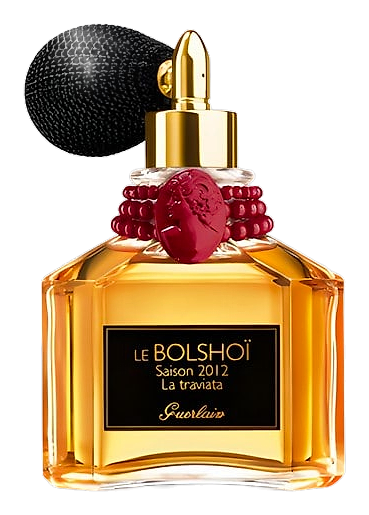
In 2011, the Bolshoi Theater reopened its historic Main Stage after extensive renovation. Guerlain, as one of the project's sponsors, marked the occasion with a limited edition fragrance. Only 400 bottles were released on October 27th, a day before the official reopening. Jean-Paul Guerlain composed Le Bolshoi as a tribute to the theater world, its rituals, its intimacy, its particular kind of magic. This was not a fragrance meant to stand at the front of a room. It was meant to be felt in the wings.
What makes this composition unusual is its structure. The top opens with neroli and bitter orange, bright and almost astringent, like backstage fluorescent light. But the heart pivots sharply into violet powder and indolic jasmine, the scent of rouge, of powders kicked up by a dozen dancers changing between acts. The ylang-ylang adds a tropical warmth that seems borrowed from another climate entirely. Then the incense arrives, not as smoke but as warmth, and the tonka-vanilla base becomes the dressing room after the show, quiet and intimate. It's a fragrance that smells like a place rather than a person.
The evolution
The opening hits immediately: bergamot, bitter orange, petitgrain. Clean, bright, almost clinical. Within minutes the neroli takes over, softening everything. The citrus retreats. The violet powder rises. Now it's warm. Now it's intimate. The jasmine and ylang-ylang arrive around the 20-minute mark, bringing a humid, tropical sweetness that contrasts sharply with the cool citrus opening. This is the costume change. This is the shift from rehearsal to performance. The incense announces itself around hour two, not as a smoky punch but as a warm undercurrent. By hour three, the drydown is all tonka bean and vanilla and close skin. Musk. The kind of scent that survives a handshake and lives in the fabric long after. Six to eight hours on most skin, intimate sillage throughout.
Cultural impact
Le Bolshoi 2011 Edition Limitée emerged as Guerlain's tribute to the historic reopening of the Bolshoi Theater's renovated Main Stage in Moscow after a six-year renovation. Only 400 bottles were produced, each numbered, transforming this fragrance into a collectible artifact. Created by Jean-Paul Guerlain during his final years with the house, it represents a convergence of Parisian haute parfumerie and Russian theatrical grandeur. The fragrance captures the intimate atmosphere of a velvet-draped opera box, the anticipation before the curtain rises, and the backstage warmth of performers gathering after a performance. Its discontinuation and scarcity have elevated its status among collectors, making it a sought-after piece in vintage Guerlain circles.
The House
GuerlainGuerlain stands as one of the oldest and most revered perfume houses in the world, founded in Paris in 1828 by Pierre-François-Pascal Guerlain. What began as a boutique on rue de Rivoli quickly became the preferred destination for Parisian society, attracting dandies and elegant women who sought custom-crafted fragrances. The house's influence grew to such heights that Guerlain earned the title of Official Perfumer to Napoleon III after presenting Eau de Cologne Impériale to Empress Eugénie as a wedding gift in 1853. This royal patronage marked the beginning of Guerlain's enduring association with European aristocracy, as the house went on to create fragrances for Queen Victoria and Queen Isabella II of Spain. Today, under the creative direction of Thierry Wasser, the fifth-generation perfumer, Guerlain continues to shape the landscape of fine fragrance with a portfolio spanning over 1,100 olfactory creations. The house remains headquartered at its legendary Champs-Élysées mansion, a historic monument that anchors Guerlain's position at the intersection of heritage and contemporary luxury.
The Creator
Jean-Paul GuerlainJean-Paul Guerlain's style resists easy categorization, though richness and depth define nearly every composition. He favored opulent oriental structures, warm woods and resins, and florals treated with almost sculptural precision.