
The Story
Why it exists.
The beginning
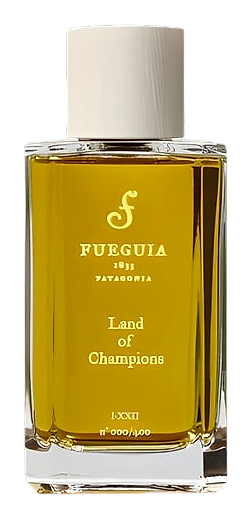
Land of Champions came out of Fueguia 1833's Destinos collection in 2022. The name points straight at the country's potreros, those improvised soccer pitches where grass meets dust and futures play out in real time. Julian Bedel composed it as a tribute to that geography, the borrowed fields, the hopeful air. With Land of Champions, the field becomes the brief: green at first spray, grassy and bright, rolling out across the skin like an opening whistle. Pepper flickers just below the surface, a sharp little impulse that keeps the first hour alive. The oud arrives not as a heavy Eastern statement but as a quieter, slightly balsamic wood, warm and bowed rather than smoked.
The interesting choice here is the oud. Bedel uses a Patagonian interpretation rather than the dense, barnyard-heavy agarwoods of the Middle East, which lets the oud read woody and slightly balsamic instead of heavy or animalic. That decision opens room for the pampas grass to remain a clear voice through the opening stages, catching the light and staying bright. Jasmine and violet add lift without tipping the composition into something thin, while a whisper of palo santo threads through the middle, contributing a faint incense-like coolness.
The evolution
The first thirty minutes are all green snap and citrus-pepper lift, the pampas grass catching light like wind through a field. Then something quieter sets in. The oud arrives not as smoke but as a warm, almost tea-like wood, and the musk underneath begins to register close to skin, turning the composition inward. The jasmine and violet gradually fade into a soft floral hum you almost have to lean in for, a gentle murmur beneath the wood. What remains is a woody-musky close, subtle on a sweater, unmistakable up close. In the final hours, the projection softens considerably, but the scent itself stays coherent, a quiet line drawn through the day. It rewards patience.
Cultural impact
Within Fueguia 1833's lineup, Land of Champions reads as the piece tied to Argentine soccer culture and the improvised pitches where the country's informal game plays out. The fragrance names a specific geography, the potrero, and wears that reference proudly rather than translating it into generic sport codes. It pulls wearers who want something rooted in place, who respond to compositions that take a regional identity seriously and carry it through the bottle without dilution. The result is a green-woody scent that holds onto its Argentine inflection, refusing to fold the country's visual language into a more universal register.