The Story
Why it exists.
The beginning
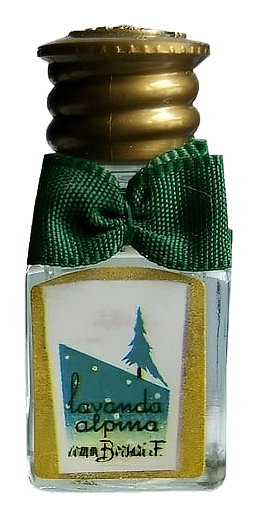
Borsari introduced Lavanda Alpina in 1929, and the composition arrived quietly, the way most of the house's work seemed to: without fanfare, without a campaign, without the loud posture that marked so many launches from that era. Two notes carry the entire weight of the fragrance: lavender and moss, and nothing complicates the picture. It reads as a piece built for someone who wanted freshness without ornament, the kind of clean that comes from cold rather than effort. Lavender carries the burden, sharp and camphoraceous from the first spray, leaning into an herbal austerity rather than the softer sweetness that lavender sometimes carries.
Two-note compositions aren't shortcuts. They're statements. Lavender carries the entire aromatic architecture here, and moss gives it somewhere to land. The lavender in question reads sharper and more camphoraceous than what mass-market perfumery typically offers, the kind that hits the back of the throat rather than wrapping around the wrist. It has presence, and an herbal bite that holds through the first hour of wear.
The evolution
Lavanda Alpina opens with the lavender front and center, and it doesn't really move. That's not a complaint, it's the point. The first thirty minutes are bright and camphoraceous, almost mentholated at the edges, the kind of crispness you associate with cool herbal extracts rather than sun-warmed fields. The lavender softens slightly as time passes, losing some of its initial bite but keeping its herbal clarity intact. By the second hour the moss starts to surface, not as a dramatic reveal but as a slow tide. It greenens the lavender, dampens it slightly, adds a vegetal weight that wasn't there at the start. The two notes end up sharing the space rather than one dominating, and the balance holds through the middle of the wear.
Cultural impact
Lavanda Alpina occupies a distinctive place among discontinued Italian fragrances, valued by collectors who appreciate the lean, herbal compositions that defined a certain strain of European perfumery. It belongs to a category of scents built on minimalism, two-note structures that achieve their effect through clarity rather than complexity. Now discontinued, it stands as a surviving example of how restraint could produce memorable results, a composition built for wearing rather than displaying. For collectors of vintage Italian perfumery, Lavanda Alpina carries genuine appeal precisely because it refuses to overstate its case.