The Story
Why it exists.
The beginning
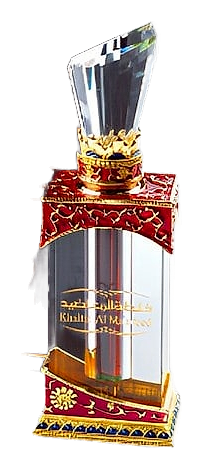
Khaltat Al Ma'adeed reads as a statement of intent from Al Haramain Perfumes, a house that treats fragrance as an ongoing dialogue rather than a series of limited gestures. Each release is an offering, a blend meant to be worn close rather than admired from across the room. The composition is unfussy in structure, heavy in the materials that define the older Arabian tradition, and it carries the confidence of a house that has spent years working with oud, rose, and the dense resinous woods that anchor the genre. Khaltat Al Ma'adeed presents itself without fanfare, skipping the bright openings that so many modern orientals lean on and moving directly into the deeper register where the house's strengths lie.
What's interesting here is the absence of citrus, fruit, or aromatic herbs at the top. This one steps straight into the heart of the matter. Musk, ambergris, rose, oud, sandalwood, palisander rosewood, and cedar, presented as a continuous chord rather than a pyramid. The inclusion of palisander rosewood, a material rarely named on modern fragrance pyramids, gives the composition a distinctive grain, a woody dryness that weaves through the sweeter elements and keeps them from tipping into syrup.
The evolution
On skin, the opening is almost immediate in its weight. Rose arrives first but never dominates, woven into the woods from the first breath rather than introduced as a separate idea. Within the first twenty minutes, the sandalwood and oud settle underneath, the ambergris giving the whole composition a slightly saline warmth that reads as skin rather than as a sprayed product. The musk arrives quietly in the background and stays there, doing the work of making everything else feel lived-in. Cedar sharpens the edges as the hours pass, and the palisander rosewood slowly surfaces, bringing a faint pencil-shaving dryness that contrasts the earlier sweetness. The drydown is where this one earns its reputation. Six hours in, what remains is a close, warm blend of oud and sandalwood with the rose now barely perceptible, a ghost rather than a statement.
Cultural impact
Khaltat Al Ma'adeed occupies a particular place within the broader vocabulary of Arabian perfumery, one defined by its reliance on the classical materials of the tradition rather than on the brighter, more contemporary openings that characterize many modern orientals. The composition's strength lies in how it commits fully to its register, building a sustained chord of musk, rose, oud, sandalwood, and cedar without retreating into the safer territory of citrus or aromatic herbs. That commitment gives it a clear identity, one that resonates with wearers who appreciate the older, more material-dense approach to oriental composition.