
The Story
Why it exists.
The beginning
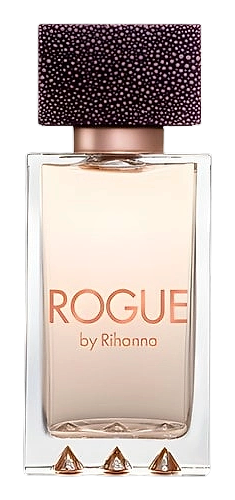
By 2013, Rihanna had established herself as someone who didn't repeat herself. Three fragrances in, she wanted something different, not another iteration of the same idea but an actual pivot. Rogue arrived in September that year, developed with perfumer Marypierre Julien, and it positioned itself as the fragrance for women navigating change. 'People are always changing and evolving,' Rihanna said at the launch. 'I made it for all women, for every mood, because we all want to project our true selves.' The name itself suggested deviation, a turn away from expectation, a path less mapped.
What makes Rogue's structure interesting is the way suede operates as both heart and anchor. It's not a note you encounter often in mass-market celebrity fragrances, more associated with high-end leather goods than scent composition. Here it sits between the fruity-floral opening and the warm base, acting as a bridge that keeps the sweetness from floating away entirely. Plum adds fruit without juiciness, more like a preserve than fresh skin. The result is a fragrance that reads as feminine without performing it, soft, but with weight.
The evolution
The opening arrives quickly: lemon blossom and cyclamen create a bright, almost dewy first impression that lasts about fifteen minutes before the florals begin to recede. The handoff is subtle, cyclamen fades, jasmine and suede rise. The suede becomes the dominant texture within the first half hour, smooth and almost edible alongside the plum. Rose appears in the background, not leading but supporting, keeping the heart warm. By the second hour, patchouli arrives, earthy, grounding, the counterweight the composition needed. Vanilla moves closer to skin, amber and musk layer underneath. The drydown is intimate and close, lasting another four to six hours depending on skin chemistry, with suede and patchouli holding the longest.
Cultural impact
Rogue arrived during a transitional moment for celebrity fragrances, the category was beginning to move away from safe, mass-appeal formulas toward something with more identity. The suede and plum combination set it apart from its peers, appealing to wearers who wanted something with actual character rather than just brand recognition.
The House
RihannaRihanna built her fragrance portfolio in two distinct chapters. The first ran from 2010 to 2018 through a partnership with fragrance house Parlux, producing eleven scents including the breakout Reb'l Fleur and the provocative Rogue line. The second began with Fenty Eau de Parfum, launched under her LVMH partnership with Fenty Beauty in 2019. The genderless Fenty scent draws from her Barbadian roots and global travels, featuring notes and inspirations tied to Bridgetown, Barbados, Grasse, France, and New York City. Unlike celebrity fragrances that typically target a single demographic, the Fenty release positioned itself outside traditional gender segmentation, reflecting the inclusivity that defines the broader Fenty brand. Her fragrance work spans budget-friendly flankers and premium expressions, each carrying her personal stamp and cultural reach.
The Creator
Marypierre JulienHer signature lies in botanical precision and a particular gift for translating natural beauty into wearable form. Julien gravitates toward floral and herbal accords, her French sensibility softened by a Mediterranean directness.