
The Story
Why it exists.
The beginning
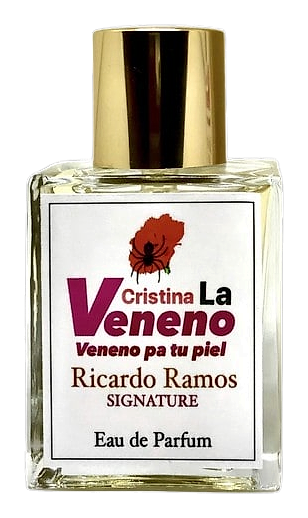
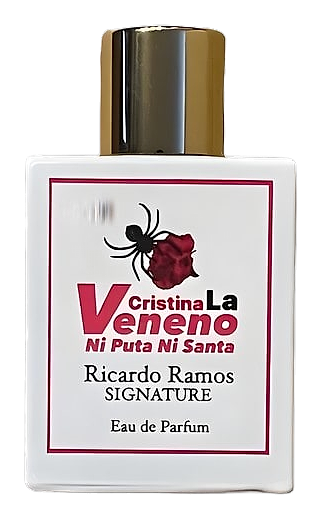
Cristina La Veneno was already a statement, hypersexualized audacity wrapped in rose and berry jam. The flanker Ni Puta Ni Santa dials back the provocation while keeping the pulse. Ricardo Ramos replaced the rose with passion fruit, the berry jam with vanilla's fruity edge, and traded the gin note for agarwood and aromatic resins. The result: the same sensual charge, but filtered through something more playful, more naive. A version of Cristina La Veneno that hasn't decided what it wants to be yet, and is enjoying that.
What makes this structure unusual is the blood-latex-pheromone constellation sitting in the heart. Those materials are rarely used at concentrations that register, they're the stuff of clinical anatomy labs and vinyl records, not perfume bottles. Here, Ricardo Ramos threads them between passion fruit's acidity and saffron's heat, letting the skin accord read as something biological rather than synthetic. The mace in the top amplifies that sharpness, making the opening feel almost electric before the resins arrive to ground it.
The evolution
The opening announces itself without apology. Sweat and passion fruit arrive together, one mineral, one fruity, held apart by mace's spiky warmth. Thirty minutes in, the latex becomes the story: a vinyl-leather note that reads clean and almost clinical against the saffron. The blood accord fades faster than expected, but its metallic trace lingers in the heart's background, giving everything after it a faint iron edge. By the third hour, oud and frankincense have taken over, the vanilla settling beneath like a warm floor. Guaiac wood keeps it from getting too heavy. On fabric, it outlasts skin by several hours, the drydown of smoke and resin stays close, intimate, almost monastic compared to the opening's audacity.
Cultural impact
Ricardo Ramos positions this fragrance for the collector who treats scent as narrative, someone who wants the story in the bottle, not just the smell. The ni puta ni santa concept (neither whore nor saint) speaks to a wearer comfortable with contradiction: sweet and sharp, clean and unsettling, playful and provocative. It sits in that narrow niche of fragrances that divide rooms intentionally, for people who choose it precisely because it won't be everyone's choice.
The House
Ricardo Ramos Perfumes de AutorRicardo Ramos Perfumes de Autor creates artistic fragrances from Granada, Spain. Each scent references Andalusian history, colonial trade routes, and the cultural mix of South American expatriates who live in Granada and Istanbul. The line balances vintage ingredients such as oud, ambergris, and citrus with modern laboratory techniques, offering collectors a narrative that feels both scholarly and sensual. Recent releases like HooDoo Blues (2023) and Manigua (2025) illustrate the brand’s ongoing dialogue between past and present, while older classics such as AGUA DE BARCELONA (2004) remain reference points for the house’s evolving language.
The Creator
Ricardo RamosRamos gravitates toward opulent, characterful compositions that refuse to disappear into the background. Oriental structures appear frequently in his work, as seen in Cristina la Veneno, an assertive unisex fragrance that takes its name from Spanish cultural iconography and wr…