The Story
Why it exists.
The beginning
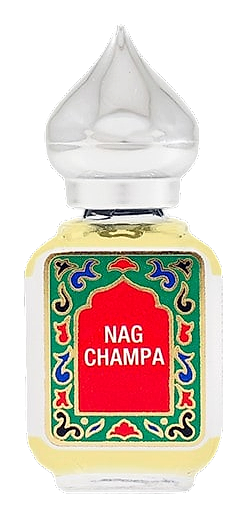
Nag Champa draws its name from one of India's most recognized fragrance families, the champa flower, and the incense blends built around it for centuries. Nemat International introduced this composition as part of their Kohinoor collection, an offering that reads like a direct translation of Indian floral tradition into a perfume oil format. The format matters here: a perfume oil rather than a spray, alcohol-free, rooted in a floral-green balance that feels both ancient and immediately wearable. The oil presents its character slowly, the way a flower opens rather than how a synthetic accord announces itself. There's no top-note flash, no alcohol lift carrying the first impression into the air before it settles.
What makes Nag Champa interesting as a composition is what it leaves out. Many champa interpretations stack heavy resinous materials and dense wood bases into something that reads as ceremonial, smoky, almost architectural. Nemat's version strips the architecture down to a single bright floral, tuberose, and lets green notes carry the structural load. The result is less temple than garden. Less smoke than stem. It's a quieter statement than the name suggests, and that restraint is arguably the point.
The evolution
Nag Champa opens with tuberose in full bloom, creamy and unmistakably indolic. The sweetness arrives immediately, dense and slightly waxy, the unmistakable scent of petals opening in warm air. Within the first 15 minutes, green notes slide underneath, pulling the sweetness back from cloying and introducing a sharper, almost bitter counterpoint. What develops is a push-pull: lush floral meeting cool, almost crushed-leaf bitterness. The green notes carry a vegetal snap at first, something close to torn stems or freshly cut grass, and this sharpness gradually softens as the composition warms against the skin. An hour in, the tuberose has mellowed but never disappears. It becomes warmer, more like the lingering trace of a flower pressed between pages than a living bloom on the stem.
Cultural impact
Nag Champa sits in an interesting category: a fragrance that borrows its name from one of India's most recognized scent traditions, yet arrives as a quiet, simplified oil rather than an opulent incense composition. The name carries expectations of smoke, resin, sandalwood, the dense atmospheric weight of temple incense. The actual fragrance offers something else entirely: a tuberose-forward floral with green accents, clean where the name suggests heavy, bright where tradition implies dark. That contrast between expectation and delivery is part of what makes the composition memorable.