
The Story
Why it exists.
The beginning
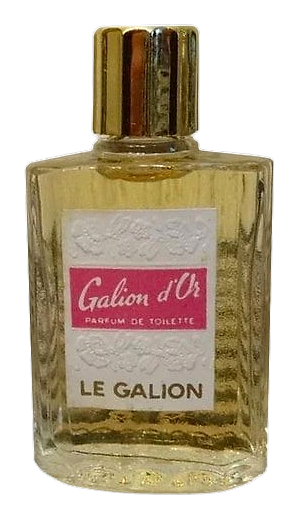
Galion d'Or arrived from Le Galion in 1930, composed by Paul Vacher. The formula leans on aldehydes and violet, an unusual pairing that marked a deliberate departure from the more conventional florals of its moment. The combination has a particular logic: aldehydes give the structure a crisp, almost architectural lift, while violet brings the powder and the softness beneath. Galion d'Or reads as a study in contrast, a scent that holds its brightness without ever tipping toward shouty. It is built from restraint, from notes that refuse to perform, and the result feels more like a tailored garment than an ornament.
Le Galion used aldehydes here with a clear intention: to give the composition a clean, architectural lift rather than a decorative sparkle. Violet brings the powder, the soap, the old-fashioned femininity, but the aldehydes prevent it from ever feeling nostalgic or overly soft. The accord lands somewhere between a clean bar and a serious bouquet, two ideas that should not coexist and yet somehow do. The aldehydes behave almost like tailoring, holding the shape of the fragrance while the violet softens the edges and rounds out the silhouette.
The evolution
Galion d'Or opens with a brisk aldehyde sparkle that flashes bright and metallic, almost like cold steel in morning air. As that initial chill softens, violet begins to assert itself, building toward a powdery, soapy plushness that feels both familiar and slightly austere. The aldehydes never fully recede; they remain as a kind of scaffolding underneath, keeping the violet from collapsing into something too sweet or too sentimental. The accord settles into a clean, powdery trail that feels closer to couture than to spectacle. Each stage hands off gracefully to the next, so the scent never shouts yet never disappears either, hovering close to the skin like a favorite silk scarf worn through long afternoons. The drydown keeps that powdery violet character intact, sustained by the aldehydes until the very last trace on the wrist.
Cultural impact
Galion d'Or has earned a quiet reputation among collectors as an aldehyde-driven composition that showcases what restraint can achieve when paired with violet. It is often mentioned alongside other aldehyde-based fragrances from the same period, sharing a family resemblance without losing its own voice. Wearing it feels less like a statement and more like a quiet credential, a way of signaling familiarity with vintage French perfumery without drawing attention to the fact. The fragrance belongs to a lineage of aldehydic classics, and its early placement within that tradition gives it a particular standing among those who follow the genre.