The Story
Why it exists.
The beginning
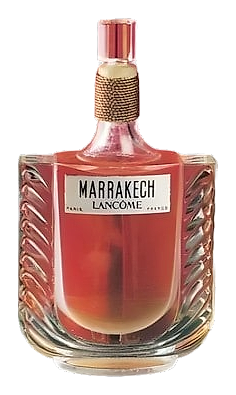
Marrakech arrived in 1946 from the house Armand Petitjean had built eleven years earlier, a French beauty name rooted in a perfumer's own vision. The name alone signals the brief: a North African city rendered through the language of French perfumery. Petitjean composed it himself, layering aldehydes over a heart of Turkish rose and orange blossom, then grounding everything in Mysore sandalwood and resins. It was advertised at the time with illustrations by Edmond-Maurice Pérot, a detail that places it within a specific visual moment. The bottle itself was designed by Marc Lalique, a crystal object that gave the fragrance a weight and presence beyond what liquid alone could carry. This was perfumery as object, as souvenir, as small piece of elsewhere.
What separates Marrakech from its 1940s peers is the density of the base. Mysore sandalwood anchors a foundation that also includes ambergris, labdanum, benzoin, and tonka bean. The aldehyde opening is there, but Petitjean threaded it with actual orange, giving the brightness a fruit-skin bitterness rather than the abstract sparkle aldehydes often carry on their own. The leather and oakmoss tucked into the base give the composition a savory, almost smoky dimension, then the vanilla and ambergris pull it back into the sweet, resinous territory the name promises.
The evolution
The opening belongs to aldehydes and orange, a bright, slightly waxy sparkle that reads almost effervescent, like citrus oil pressed between cold fingers. Then the orange blossom and Turkish rose arrive together, joined by a flicker of spice that warms the edges without dominating. The heart reveals a dense white floral sweetness layered with the dusty warmth of rose attar, a material that carries its own weight. As the composition settles, the sandalwood takes over, creamy and full, carrying vanilla, tonka, and labdanum underneath. The leather and oakmoss surface in the late stages, adding a faintly animalic edge that keeps the sweetness from going soft. What lingers is the sandalwood-vanilla-ambergris combination, a warm, skin-like hum that reads more intimate than the opening promised. On fabric, the benzoin and vanilla still register, faded but unmistakable.
Cultural impact
Marrakech is one of three compositions advertised together with Flèches and Tropiques, a grouping that situates it within a specific moment in the house's early output. Its bottle, designed by Marc Lalique, reinforced that sense of occasion, crystal as packaging, fragrance as keepsake. Today, with production apparently discontinued, the fragrance exists primarily in memory and in the bottles that remain in circulation. It is appreciated by wearers who value the density of its base and the era it represents, a composition that prioritized material richness over accessibility.