The Story
Why it exists.
The beginning
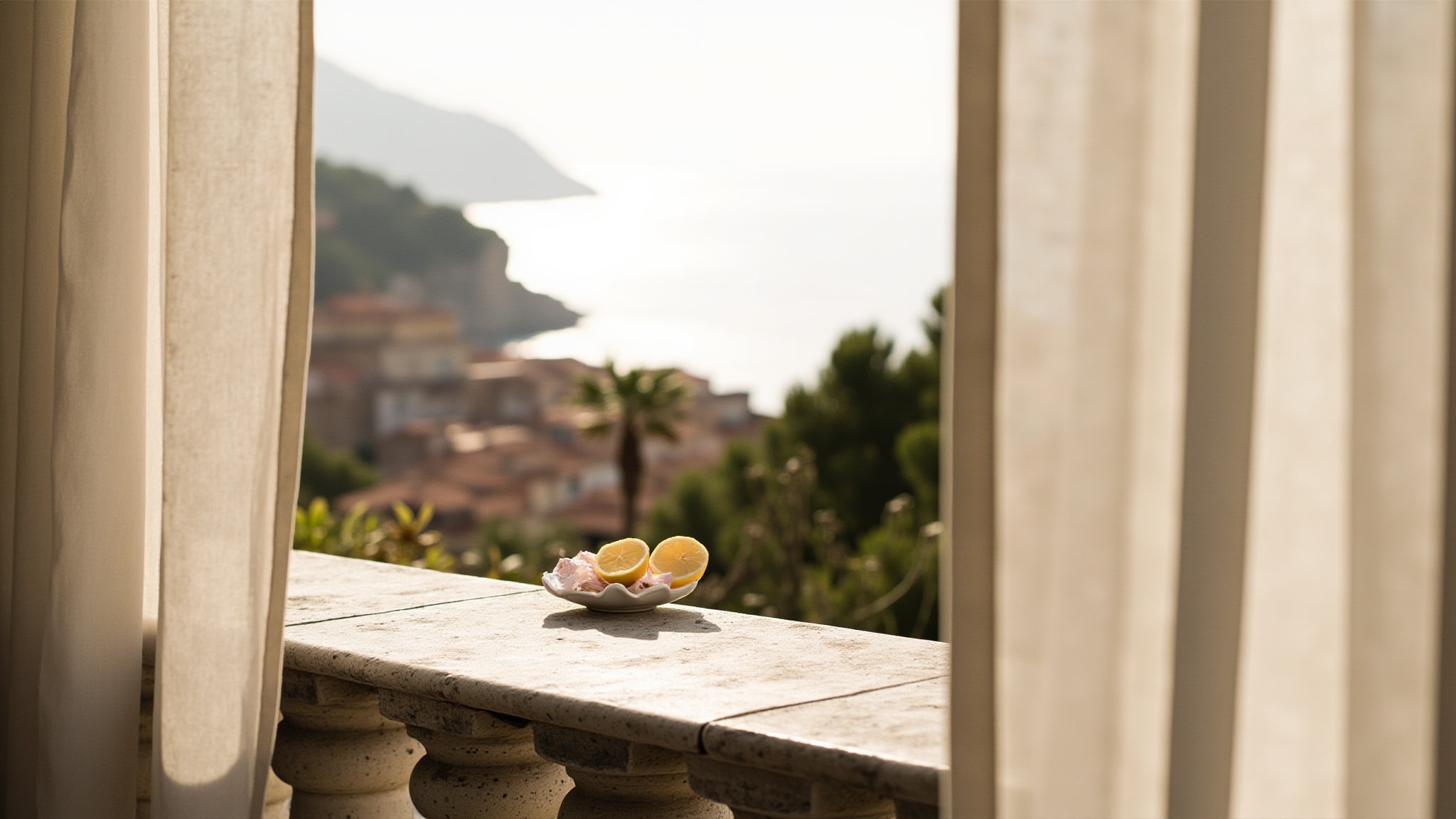
Bordighera is a small town in Italy where lemon groves meet the Mediterranean, a place known for its mild climate and coastal beauty. In 1920, an Italian playwright named Mr. Adami commissioned Albert Krigler to bottle the feeling of his vacations there, a villa stay surrounded by citrus trees and sea air. Krigler's answer was a composition built almost entirely around that specific place: Sicilian bergamot, lemon, grapefruit blossom, rose absolute, and the quiet warmth of cashmere woods. Named for the villa itself, Villa Bordighera 20 captures what it feels like to step outside into that particular stretch of Italian coast, where citrus fragrance hangs in the air and the sea breeze carries warmth from the stones.
What makes this composition unusual is its discipline. Where many citrus fragrances pile on florals and woods to build complexity, Krigler kept the architecture narrow: citrus on top, citrus blossom and rose in the middle, a single woody note underneath. The cashmere woods do the heavy lifting in the base, providing a skin-like softness that gives the composition a warmer foundation than most straightforward citrus builds. The rose absolute is just present enough to round the sharpness of the bergamot without turning the scent floral.
The evolution
The first fifteen minutes are pure citrus, almost aggressive in their brightness, a sharp burst of bergamot with that characteristic green-tart snap. Grapefruit adds a slightly bitter edge, the lemon brings that clean, almost sour snap, and together they announce themselves with confidence. By the thirty-minute mark, the grapefruit blossom and rose absolute emerge, softening the opening into something more rounded, less sharp. The rose is quiet here, a whisper rather than a statement, but it changes the whole texture. After two hours, the cashmere woods take over. The citrus doesn't disappear, it just retreats to the background, while the woods create a warm, soft feeling on skin that reads almost suede-like in its smoothness. Six hours in, what remains is that woody softness with a trace of citrus still clinging to fabric.
Cultural impact
This composition finds its setting in spaces that echo its origins, a terrace overlooking a garden, a sun-warmed courtyard, the kind of places where citrus notes feel native and the woods ground the composition against warm stone. It carries the atmosphere of midday in a Mediterranean garden, where the citrus notes mirror the fruit growing nearby and the woody base provides an anchor of warmth. The scent reads as an extension of its place of inspiration rather than an abstract citrus cologne, offering a transportive quality that rewards attention.