
The Story
Why it exists.
The beginning
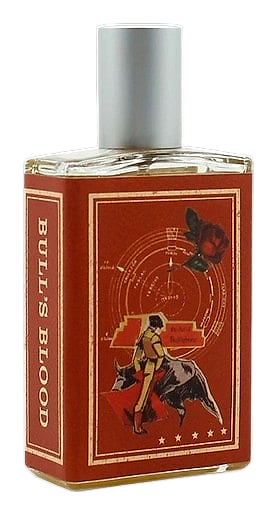
Every bottle of Bull's Blood begins with a man named Devante Valéreo, a Spanish author raised on the Balearic Sea, whose father was an ex-picador. Valéreo wrote a novella so lurid it drew obscenity charges. A ban followed. He vanished in 1967 after a bar scuffle with American sailors, one of whom died from his injuries. 'A man who has killed is a man who knows passion,' he wrote. Josh Meyer translated that sentence into a fragrance.
The 'blood' in the name isn't literal, it's the iron scent of heated skin, of sun on flesh, of something alive. Costus root brings an animalic edge that Western perfumery mostly abandoned decades ago. Combined with black musk and dark patchouli, it creates a dense, earthy foundation that rose and tobacco only partially soften. This isn't a polite fragrance. It's a literary one.
The evolution
The opening hits metallic, rose spiked with costus, that animalic bite that makes you lean closer. Black musk threads through immediately, sweetening the edge just enough. Within the hour, patchouli and tobacco take over. The rose retreats but doesn't vanish. By the third hour, you're in the drydown: warm skin, dark earth, the ghost of tobacco leaf. It stays close. Intimate. The kind of scent someone notices only when they're already beside you.
Cultural impact
Bull's Blood divides wearers sharply. The costus root and blood accord create something animalic and confrontational, not everyone can wear it, and not everyone who tries will love it. But those who connect with it tend to connect deeply. It occupies a rare space: a literary fragrance that actually demands something from the wearer.

![Mercury [80hg] by One of Those](https://pkjcevljwhrjwpswgpkp.supabase.co/storage/v1/object/public/fragrance-images/bottles/one-of-those/mercury-80hg.png)

![Lithium [3li] by One of Those](https://pkjcevljwhrjwpswgpkp.supabase.co/storage/v1/object/public/fragrance-images/bottles/one-of-those/lithium-3li.png)