
The Story
Why it exists.
The beginning
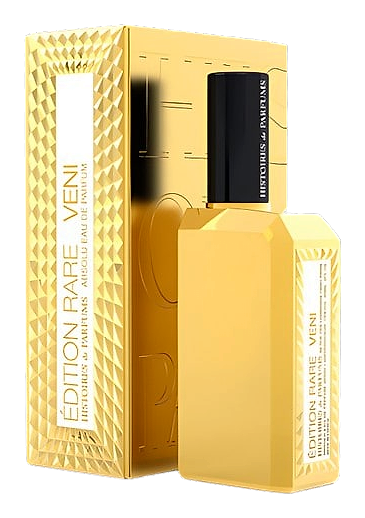
Veni takes its name from the first word of Caesar's legendary dispatch: 'I came.' Not the conquest itself, but the arrival, the moment after the journey, when the traveler's hand finally touches what they crossed the world to find. Gérald Ghislain designed it as the opening chapter of the Les Trois Ors collection, a trio built around the idea of gold in different forms: spice-gold, wood-gold, resin-gold. Veni is the spice-gold. The fragrance captures that specific feeling of reaching a destination after something difficult, not the struggle, but what waits on the other side.
What makes Veni unusual is the way it holds contradiction in the opening. The cardamom absolute is almost clinical in its clarity, sharp and green. Cinnamon adds heat. But then lavender walks in and changes the temperature, cool, herbal, almost medicinal. On paper, it shouldn't work. In the air, it does. That tension between sharp and soft, heat and cool, is where Ghislain's gastronomic background shows most clearly: he understands how opposing flavors can elevate each other, how a dish needs contrast to have character. The same logic applies here.
The evolution
The first twenty minutes belong to the spices. Cardamom and cinnamon dominate, with galbanum adding a green, almost bitter edge that keeps things from going sweet too early. The lavender reads as a cool undertone, aromatic, slightly medicinal, rather than a floral note. It's not comfortable exactly, but it's alive. Around the thirty-minute mark, the saffron arrives. This is the shift. Warmth takes over from sharpness. Guaiac wood and marigold (tagette) layer in, giving the heart a golden, slightly animalic richness. The carnation note, the one mentioned in the brand's own description, shows up here too, sweet and almost waxy, blending with the saffron rather than standing apart. By hour two, the base begins to assert itself. Ambergris is the quiet structural element: it doesn't shout, but it holds everything together, giving the drydown a marine-animalic depth that keeps the sweetness from becoming cloying. Caramel and vanilla take over the foreground. Patchouli and benzoin add resinous warmth.
Cultural impact
Veni arrived in 2012 when the niche fragrance market was still finding its footing, and it arrived with a clear thesis: spice doesn't have to be loud to be lasting. The Histoires de Parfums house built its identity on storytelling, and Veni, as the spice-gold in the Les Trois Ors collection, carries that literary weight. The reference to Caesar's victory phrase wasn't marketing copy, it was a statement about intentionality, about arriving somewhere with purpose. This mattered because 2012 was the era of blockbuster flankers and mass-market Oud; Veni offered something different: complexity without aggression.