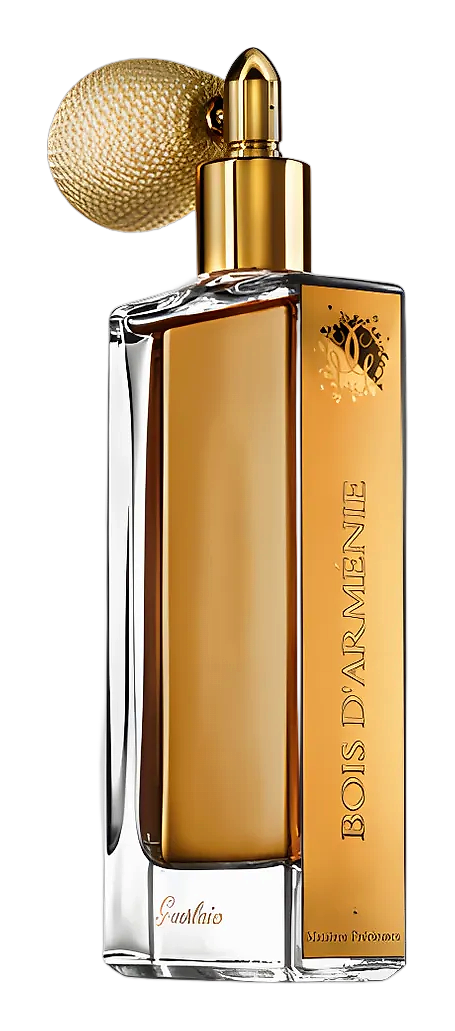

The Story
Why it exists.
The beginning
The name is the brief. Armenian paper, those thin benzoin-soaked strips that perfume lovers have burned for decades, became Annick Ménardo's raw material. Not an homage, exactly. More like a translation. The house gave her a smell that already existed in culture, in ritual, in memory, and asked what it would become if Guerlain made it permanent. Ménardo reached for frankincense first, then softened the blow with iris. The result sits between prayer and warmth, the smell of something that burned a long time ago, still settling into the room.
What makes this unusual is the iris-benzoin pairing. Usually iris acts as a bridge, a middle voice between top and base. Here it sits in the opening alongside frankincense, adding a cool powder note that keeps the incense from reading as purely masculine. The guaiac wood in the heart is where the wood of the name arrives: smoky, a little tar-like, not quite cedar. Copaiba balsam replaces the styrax you'd find in a literal Armenian incense blend, it's sweeter, more vanillic, and it gives the base its long finish. The whole structure is designed to evolve rather than announce.
The evolution
The opening hits immediately: frankincense smoke, but not sharp, rounded by the iris powder that arrives within minutes. The pink pepper barely registers as spice; more like a flicker of warmth behind the main act. By the second hour, guaiac wood and benzoin have taken over. The smoke is still there but it's settled into something warmer, less church, more intimate room. The drydown is where time shows its hand. Copaiba balsam and white musk settle close to the skin. Patchouli adds its earthy depth but doesn't push. Eight hours in, you're finding traces on fabric. The next morning, it reads as warm resin and clean skin, the kind of smell that makes people ask what you're wearing without expecting a complicated answer.
Cultural impact
Bois d'Arménie developed a quiet following among Guerlain collectors who prize it for its unconventional opening, the iris powder sitting alongside frankincense rather than below it. It's been discontinued, which has only sharpened its cult status. The fragrance occupies a specific space: not quite niche, not quite mainstream, defined by its willingness to open cool and end warm.
The House
GuerlainGuerlain stands as one of the oldest and most revered perfume houses in the world, founded in Paris in 1828 by Pierre-François-Pascal Guerlain. What began as a boutique on rue de Rivoli quickly became the preferred destination for Parisian society, attracting dandies and elegant women who sought custom-crafted fragrances. The house's influence grew to such heights that Guerlain earned the title of Official Perfumer to Napoleon III after presenting Eau de Cologne Impériale to Empress Eugénie as a wedding gift in 1853. This royal patronage marked the beginning of Guerlain's enduring association with European aristocracy, as the house went on to create fragrances for Queen Victoria and Queen Isabella II of Spain. Today, under the creative direction of Thierry Wasser, the fifth-generation perfumer, Guerlain continues to shape the landscape of fine fragrance with a portfolio spanning over 1,100 olfactory creations. The house remains headquartered at its legendary Champs-Élysées mansion, a historic monument that anchors Guerlain's position at the intersection of heritage and contemporary luxury.
The Creator
Annick MénardoDark, smoky, and beautifully resolved. Menardo has built her reputation on bold contrasts: leather against sweetness, wood against air, shadow against light.