
The Story
Why it exists.
The beginning
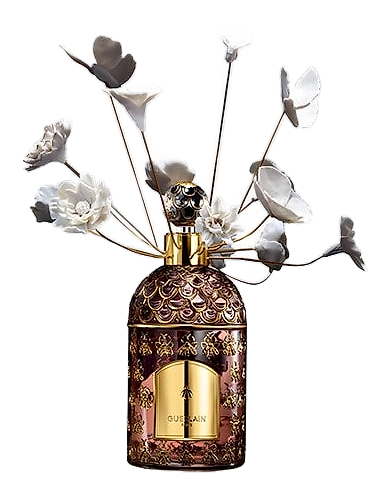
In 1853, Pierre-François-Pascal Guerlain crafted the Abeilles bottle for Empress Eugénie on her wedding day to Napoleon III. One hundred and seventy years later, Guerlain commissioned artist Céline Cléron to reimagine that icon. Her vision: a miniature porcelain biscuit garden where bees and butterflies flutter around 24-carat gold flowers. Bee Garden is the scent that lives inside it. Thierry Wasser composed the fragrance to match the whimsy, a crisp rhubarb opening, luminous neroli at the heart, black tea and cedar as the quiet foundation.
Rhubarb in perfumery is rare. It brings a tartness that most florals avoid, a sharpness that wakes the nose instead of flattering it. Neroli then softens the entry, offering that clean, almost soapy white floral brightness that works as both a bridge and a destination. The black tea note is the surprise: it adds texture, a faintly tannic warmth that prevents the whole composition from floating away. Cedar and sandalwood keep everything grounded in something woody and real. The pyramid is simple by design, three stages, no confusion.
The evolution
Bee Garden opens on a high note. The rhubarb hits sharp and green, almost vegetal, lasting only a few minutes before neroli sweeps in. That transition matters: the fragrance shifts from tart to luminous without ever getting sweet. The white floral heart, neroli, jasmine, a soft rose accord, carries the middle hour, bright and clean and unapologetically floral. Then black tea and cedar arrive together, threading warmth through the composition like a whispered secret. The drydown stays close to the skin, intimate rather than announced. On most skin types, expect four to six hours of wear before the base settles into something quiet and persistent.
Cultural impact
A limited edition released in 2023 to mark the 170th anniversary of the Abeilles bottle, originally created for Empress Eugénie's wedding to Napoleon III. The bottle, designed by Céline Cléron, transforms the iconic bee motif into a whimsical porcelain garden, a collectible object as much as a fragrance. The Guerlain community has responded warmly, with wearers consistently praising the crisp rhubarb opening and the clean floral heart as a refined and elegant interpretation of the house's signature style. The fragrance's restrained character means it appeals primarily to those seeking subtle sophistication rather than bold presence.
The House
GuerlainGuerlain stands as one of the oldest and most revered perfume houses in the world, founded in Paris in 1828 by Pierre-François-Pascal Guerlain. What began as a boutique on rue de Rivoli quickly became the preferred destination for Parisian society, attracting dandies and elegant women who sought custom-crafted fragrances. The house's influence grew to such heights that Guerlain earned the title of Official Perfumer to Napoleon III after presenting Eau de Cologne Impériale to Empress Eugénie as a wedding gift in 1853. This royal patronage marked the beginning of Guerlain's enduring association with European aristocracy, as the house went on to create fragrances for Queen Victoria and Queen Isabella II of Spain. Today, under the creative direction of Thierry Wasser, the fifth-generation perfumer, Guerlain continues to shape the landscape of fine fragrance with a portfolio spanning over 1,100 olfactory creations. The house remains headquartered at its legendary Champs-Élysées mansion, a historic monument that anchors Guerlain's position at the intersection of heritage and contemporary luxury.
The Creator
Thierry WasserWasser gravitates toward green, crispy notes and the bold florals Guerlain is known for. Bulgarian rose appears repeatedly in his work, and he travels annually to oversee the harvest in Kazanlak.