The Story
Why it exists.
The beginning
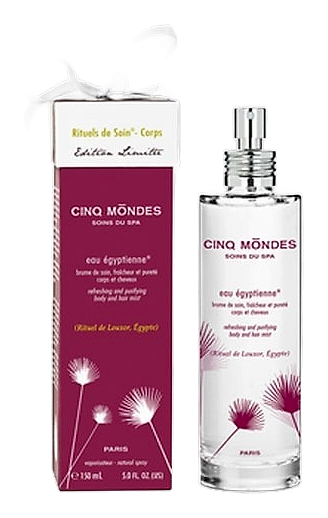
Olivia Giacobetti composed Eau Egyptienne for Cinq Mondes, a formula that draws directly from kyphi, the ancient Egyptian temple incense recipe recorded in temple texts. Lotus, jasmine, and rose anchor a composition that pulls ten essential oils into one mist designed for body, hair, and home textiles. Giacobetti's brief wasn't to recreate a museum artifact. It was to translate what those temple preparations actually felt like, the hush of resin smoke curling through stone halls, into something wearers could mist across skin and fabric. The result carries the quiet authority of something old made newly available, a botanical bridge between ritual practice and daily routine.
The interesting move lies in the sheer composition. This is a mist designed for body, hair, and linens, which means Giacobetti had to compose something that wouldn't overwhelm at pillow distance or irritate across different fabric applications. The result is a sheer architecture where mint provides the lift, the resins provide the gravity, and the florals barely whisper. It's a technical balancing act disguised as simplicity. Working with ten essential oils in a formula meant to remain calm across surfaces is a different kind of constraint than building a high-impact perfume.
The evolution
The opening reads almost green, with mint lifting the lotus and a cool, papyrus-like dryness underneath. Then the frankincense and mastic arrive, not as a wall but as a slow settling, like incense finding its level in still air. The florals, jasmine especially, surface as a warm hum rather than a statement, threading through the resin base without ever breaking its calm. As the composition dries down, the resins deepen into something meditative. Myrrh gradually replaces frankincense as the dominant note, taking on a darker, slightly bitter edge that anchors the late stages. Eventually, what's left is a low, skin-close amber-resin warmth, close enough that only the wearer tends to notice. Longevity is modest, more a quiet companion than a performance piece, and the sillage stays intimate throughout, drawing people in rather than announcing itself.
Cultural impact
Eau Egyptienne occupies a specific corner of the fragrance world. It reads as functional before it reads as luxurious, designed for pillow, hair, and body use rather than statement wear. Wearers tend to describe it in therapeutic terms, with words like calming, grounding, and stress reliever appearing in conversations about the scent more frequently than traditional perfume vocabulary. That framing places it in a category of its own, somewhere between a beauty product and a wellness tool, closer in spirit to an aromatic remedy than to a conventional fragrance. The appeal lies in its quiet utility.