
The Story
Why it exists.
The beginning
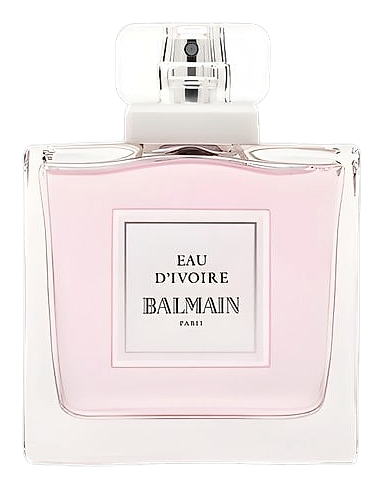
Eau d'Ivoire arrived in 2000 as Balmain's statement on what a feminine fragrance could be. The name itself, Ivory, the warm shade between white and gold, set the tone. Perfumer Daniel Hoffmann built the composition around a tension: luminous white florals that could so easily drift into delicate nothingness, anchored by a cedar and vetiver structure that refused to let go. The brief was clear. A fragrance that felt like morning light on garden petals, but held its shape when the day demanded presence.
What makes the pyramid interesting is how the heart phase transforms rather than simply fades. The ylang-ylang opens tropical and almost excessive, then settles against the skin in a way that becomes creamy, almost edible, less beach cocktail, more vanilla-adjacent warmth. The wisteria adds a powdery violet undertone that wasn't audible in the opening but emerges as the florals deepen. Meanwhile, the wild rose doesn't disappear, it recedes into the green accord, becoming structural rather than decorative. The result is a heart that reads differently every hour, depending on what your skin pulls forward.
The evolution
The first thirty minutes are all about the berries and mandarin. Bright, translucent, almost cheerful. Then the wild rose and freesia take over, pushing the citrus into the background. The transition isn't dramatic, it's the slow fade of a spotlight, one note dimming as another brightens. By the second hour, the ylang-ylang enters and the composition shifts. The florals deepen, become richer, more textured. What started as a garden in morning light becomes something warmer, more interior. The drydown arrives around hour four. Cedar emerges as the structural anchor, with vetiver providing a mineral, slightly smoky counterpoint. Vanilla and musk don't overpower, they soften, they linger. The final skin scent is warm wood and skin-close cream, present but never loud. Moderate sillage means this one stays close. It becomes your scent, not the room's.
Cultural impact
Eau d'Ivoire arrived in 2000 as a counterpoint to the heavy, sweet-oriental fragrances that dominated the late 1990s. Rather than projecting opulence through sillage, it offered something more interior, luminous white florals and creamy musk that felt personal rather than performative. The emphasis on a woody green undercurrent positioned it as a fragrance for presence rather than announcement. For wearers who wanted elegance without spectacle, it became a quiet signature.