
The Story
Why it exists.
The beginning
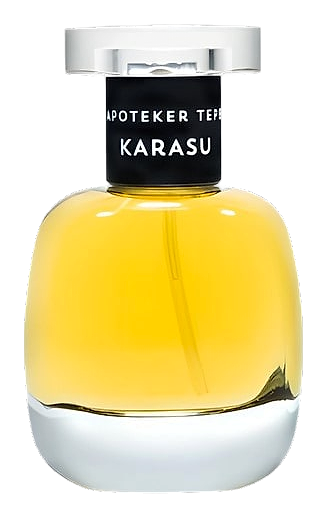
Karasu draws from Japanese mythology, the karasu tengu are crow spirits, powerful and vengeful, dwelling deep in forests. Those lost or helpless could call upon them through prayer and incense. Holladay Saltz built the composition around materials used in kōdō, the Japanese incense ritual. Costus root, Siam wood, hinoki cypress, each chosen for the spare, remarkable asceticism of smoke rising from prayer. The name is the concept: a crow that answers when called.
What makes Karasu unusual is the costus root. In perfumery, it's a signal, the material carries a bitter, almost animalic character that most modern compositions avoid entirely. Here it's placed at the heart of the pyramid, not hidden behind sweeter woods or lighter citrus. The hinoki reinforces the austere quality, this is temple wood, not cabin wood. And the paper note does something unexpected: it doesn't smell like a fresh notebook. It smells like paper that's been burning.
The evolution
The first ten minutes are the astringent phase. Cardamom hits the nose with a sharp, almost camphorated quality, while costus root announces itself as something strange, not sweet, not woody, but animalic in a way that reads as natural rather than synthetic. Then the hand-off: cardamom recedes and hinoki takes over. The wood smells clean, almost sterile, like incense sticks burning in a room with no furniture. Fujian cypress adds a slightly resinous quality underneath. The drydown is where Karasu earns its name, costus persists, mixing with the paper accord to create something that smells like old scrolls left near a brazier. This lingers. On most skin, the base notes hold for eight to ten hours. On fabric, longer.
Cultural impact
Karasu occupies a specific space in indie perfumery: the incense-ritual niche without the literal smoke that dominates that category. Where most smoky fragrances lean into literal campfire or oud material, Karasu works through suggestion, costus and paper as proxies for smoke rather than smoke itself. The response from the indie community has been polarized in the way that unusual materials usually are: those who connect with costus root describe it as the most interesting fragrance they've tried; those who find it too animalic describe it as something to avoid. This is the trade-off of working with materials that smell specific rather than safe.