The Story
Why it exists.
The beginning
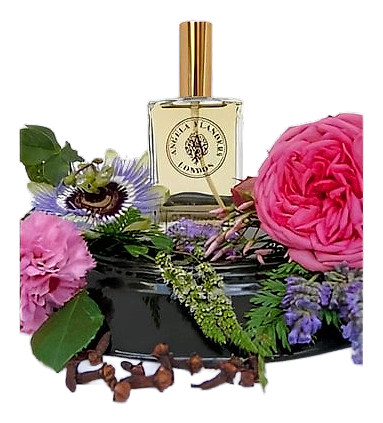
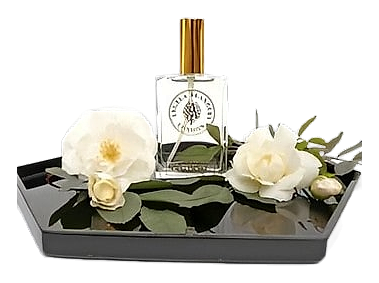
White Roses arrived in 1999 from Angela Flanders, a perfumer whose independent house has operated in London since 1985. The brand's identity has always leaned toward the handcrafted and small-batch, with compositions that read more like personal experiments than commercial releases. There's an intimacy to the way these bottles present themselves, less department-store polish and more workbench curiosity. This composition reads like an attempt to capture the rose in its most unadorned moment. Not the corsage. Not the wedding bouquet. The bunch you'd pick up on the way home because the color caught your eye, before you've done anything with it. Just stem, leaf, and the first breath of a white petal about to open.
What makes White Roses interesting is what it leaves out. There's no heavy sweetness pulling at the composition, no dense resinous undertow pulling it toward something darker. It's a stripped-back study: green notes and white rose, nothing else crowding the frame. The accords point toward a green-leaning floral first, a rose second. The structure mirrors a walk through a garden in early morning. You smell the leaves before the flowers. You catch the green and the coolness of shaded foliage before any sweetness arrives. For a note as storied as rose, that restraint is the whole point.
The evolution
The first 15 minutes belong to the green. Green notes open dense and almost vegetal, like the smell of foliage after a light rain, something alive and chlorophyll-rich rather than herbal or minty. There is something faintly citric that lifts it, not lemon or bergamot in any obvious way, more like the brightness that green leaves release when they're crushed between fingers. The rose hasn't introduced itself yet. It waits. Around the 30-minute mark, the white rose arrives, clean and slightly translucent, never the heavy, syrupy rose of an oriental composition. It sits inside the green like a petal placed on a leaf. The two never compete. Over the next couple of hours the green slowly recedes and the rose takes the foreground, gaining a soft, almost dewy quality as it warms against skin. It smells less like perfume and more like the air around a flowering bush at the edge of a yard.
Cultural impact
White Roses sits in a small category of fragrances that treat rose as a garden plant rather than a luxury symbol. This one stays green and slightly austere, closer to the plant itself than to any polished interpretation. It appeals to the wearer who finds poetry in the unpretentious, the freshly cut, the not-yet-arranged. The production was reportedly discontinued, which gives the remaining bottles a kind of quiet scarcity. They feel less like stocked inventory and more like something pulled from a drawer, a small object that has its own weather now.