
The Story
Why it exists.
The beginning
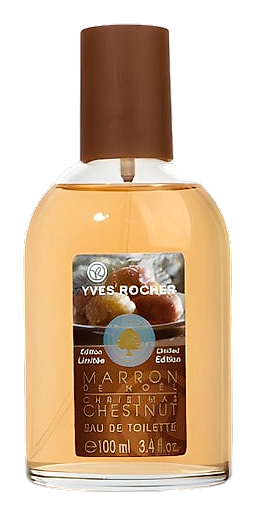
Marron de Noël arrived in 2009 as part of Yves Rocher's Les Plaisirs Nature line. The name alone sets expectations: a holiday confection bottled and worn, the kind of scent that aims to be indistinguishable from the treat it's named after. Chestnuts roasted on an open fire might be the cliché, but candied marrons glacés are the more refined cousin, a confection that turns the humble nut into something rich and dessert-adjacent. The fragrance leans fully into that direction. On skin it opens with a dense, sugary sweetness that reads as candied chestnut right from the first spray, less a toasted nut and more a chestnut that has been slowly cooked in vanilla syrup until every fiber has absorbed the sugar.
The composition is essentially a duet between two materials, and that restraint is what makes it work. Marron glacé, a candied chestnut, brings a sticky-sweet, almost honeyed nuttiness that sits somewhere between praline and roasted chestnut puree. Vanille, listed in the singular, suggests a rounded, full-bodied vanilla rather than the sharper bourbon variety. What makes this pairing interesting is the tension between chestnut's earthy, slightly starchy quality and vanilla's creamy, almost lactonic warmth. The chestnut prevents the vanilla from floating away into pure sweetness. The vanilla keeps the chestnut from reading as woody or austere.
The evolution
On skin, Marron de Noël opens with a wave of vanillic sweetness that arrives almost immediately, no slow build here. The chestnut announces itself within the first five minutes, lending a brown, roasted warmth that reads more like toasted sugar and caramelized butter than fresh nuts. There's a powdery edge to the opening, faint but present, reminiscent of confectioner's sugar dusted over a pastry. Through the first hour, the two notes braid together into a single confectionary mass. The vanilla thickens slightly, picking up a creamy density reminiscent of warm milk. The chestnut mellows, losing its sharper roasted edges and settling into something closer to chestnut honey or marron glacé syrup. By hour two, the powdery quality fades and the composition turns warmer, almost amber-like in its depth. There's no real shift toward woods or musk; this fragrance commits fully to its gourmand lane from start to finish.
Cultural impact
Marron de Noël occupies a particular place in the memories of those who wore it during its production years. It belongs to a family of gourmand fragrances that take dessert notes seriously enough to build entire compositions around them, and within that family it leans harder than most toward the confectionery end of the spectrum. Wearers tend to describe it less as a perfume and more as a sensory trigger, the smell of a grandmother's kitchen, a holiday market, or a jar of something sweet on a cold shelf.