
The Story
Why it exists.
The beginning
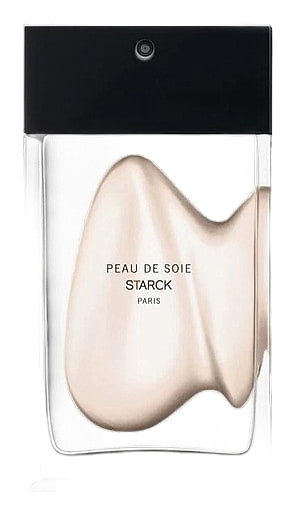
Peau de Soie, 'skin of silk' in French, arrived as part of Starck Paris, the fragrance arm of industrial designer Philippe Starck's expanding creative universe. Starck tasked Dominique Ropion, one of the most technically rigorous noses in contemporary perfumery, with translating an abstract directive into olfactory reality. The directive asked what skin feels like when it's dressed. Ropion worked with powdery notes, musk, and woody materials to construct something that would behave like a second layer, present but not obvious, warm without being heavy. The resulting fragrance embodies this tension, offering a sensory experience that feels intimately familiar yet distinctly crafted.
The heart of Peau de Soie isn't any single material. It's the tension between powdery softness and animalic depth, what one reviewer describes as occupying the same space. The woody notes here don't read as cedar or sandalwood typically do. Instead, they arrive abstract, almost mineral, supporting rather than dominating. The musk anchors everything close to the skin, creating that quality that makes this fragrance difficult to describe but immediately recognizable once encountered. The animalic is a suggestion, a warmth at the edges, not a statement.
The evolution
The opening arrives gossamer-light. Powdery, almost oblique, not sharp, not sweet, just present in a way that takes a moment to name. A reviewer described it as 'demure,' and that precision is apt. This isn't a fragrance that announces itself. For the first period of wear, it hovers at the edge of detection, playing games with the wearer's own perception. Then the animalic woods arrive. Not dramatically. Gradually. Like discovering warmth in a room you thought was cold. The transition isn't a shift, it's an addition, a shadow layer that wasn't there before. By the later hours, the drydown settles into something quieter: violet-like musky warmth, a fractionated patchouli presence that lingers close to the skin. Community feedback notes solid longevity, and what remains the next morning is the faintest trace, skin that smells like it just remembered something it didn't know it knew.
Cultural impact
Peau de Soie exists within Starck Paris, Philippe Starck's olfactory project that applies industrial design philosophy to scent. Starck Paris proposed something different: abstract sensory experiences without conventional mapping. The powdery-animalic duality in Peau de Soie positions it at the intersection of comfort and provocation, reflecting contemporary cultural tensions around authenticity and performance. The fragrance asks the wearer to consider not just what a scent smells like, but how it makes them feel and what it communicates about presence and absence.