
The Story
Why it exists.
The beginning
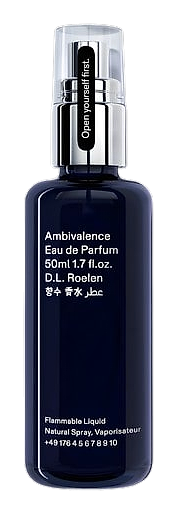
Gabriel Gabor built Ambivalence around a single contradiction: green that smokes, smoke that breathes. The name suggests a fragrance that holds two opposing states at once, freshness and depth, herb and resin, the living plant and the burned wood. D.L. Roelen's house ethos frames scent as identity work rather than decoration, and Ambivalence is the most literal expression of that. It's not a fragrance you wear to be liked. It's one you wear to find out who you are when you're not trying to impress anyone. Palo Santo provides the anchor, not as a trendy note, but as something with actual ritual weight, the kind of wood that's burned for clarity.
What makes Ambivalence structurally unusual is how the ambergris behaves. Most fragrances treat ambergris as a fixative, a smooth, warm undertow that extends everything else. Here, it pushes back. The animalic musk and oakmoss create a granular, slightly dirtfied base that grounds the immortelle's honeyed dryness rather than softening it. The frankincense keeps everything slightly elevated, slightly spiritual, but never lets you forget you're smelling something that was alive. The vanilla doesn't sweeten, it deepens. By the time you've hit the drydown, you're in hay smoke and church incense, ambergris salt, the green long gone but not forgotten.
The evolution
The opening is the most immediately arresting part. Grapefruit arrives first, bright and tart, followed closely by the green cannabis note, not the skunky end of the plant, but the chlorophyll, the leaf itself, wet and dense and unmistakably alive. This phase unfolds before the Palo Santo takes over, burnt and aromatic, turning the composition darker and smokier. The grapefruit retreats but doesn't disappear; it lingers at the edges like a memory of citrus. The heart phase settles into immortelle and dry hay, Mediterranean, sun-bleached, faintly sweet in a way that has nothing to do with dessert. The frankincense begins to thread through here, resinous and clean, lifting the heavier base notes without softening them. As the fragrance develops, you've entered the deeper stages.
Cultural impact
Ambivalence landed in 2020 as part of a collection that treats fragrance as identity work rather than sensory decoration. The confrontational hemp opening was a bold choice in a market where conventional florals and mass-appealing woods often dominate. By using cannabis as a primary note rather than an innuendo, D.L. Roelen entered territory between fragrance and conceptual art. The initial six-fragrance collection dropped all at once, inviting critics and consumers to engage with the entire vision rather than sampling one scent at a time. This batch-release approach signaled confidence in work that might divide opinion.