
The Story
Why it exists.
The beginning
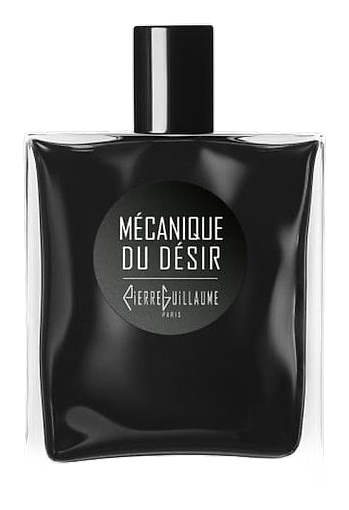
Mécanique du Désir began in a workshop. Not metaphorically, Pierre Guillaume's father restored classic cars: an Austin Healey, a Jaguar, a Mercedes. Sunday afternoons spent elbow-deep in engine grease, the smell of hydrocarbons and tar filling the space between them. Guillaume describes the attraction-repulsion of it: happy memories tangled with the penetrating edge of 'engine sweat.' Years later, reading Jacques Lacarrière's 'This beautiful and vivacious today,' he found the poetry in what he'd been carrying all along. Lacarrière called it 'Black Mucus', the hidden beauty in industrial grime. Guillaume decided to make it a fragrance. Not a nostalgia piece. A translation of that tension into aldehydes, mandarin, and the warmth of amber.
The notes aren't arbitrary. Blackcurrant bud and aldehydes outline the metallic contours, the chrome, the cold edges of machine parts. Mandarin brings brightness, the 'brilliance of chrome' as Guillaume puts it. Violet leaf and guaiac wood provide the darkness, the strange green-woody depth that shifts the composition away from clean and toward something more ambiguous. Amber and animal musks supply the warmth underneath, the human element that makes the grease smell desirable rather than just industrial. Each note serves the central tension: mechanical versus organic, clean versus dirty, attraction versus repulsion.
The evolution
The opening is aldehydic and bright, citrus over metal, the mandarin cutting sharp against the aldehydes like a spark plug firing. Blackcurrant bud adds a sulfurous green edge that keeps it from being merely clean. Within 20 minutes, the violet leaf arrives, green and slightly indolic, and the guaiac wood introduces a smoky, almost tar-like darkness. The citrus doesn't disappear, it retreats, becoming a distant brightness underneath. The drydown is where the fragrance earns its name. Amber and animalic notes surface, warm and close to the skin. The metallic edge softens into something skin-like, almost intimate. Eight to ten hours later, on fabric, there's still a trace, faint amber and the ghost of green. On skin, it fades earlier but leaves a warmth that feels like the memory of heat.
Cultural impact
Part of Collection Noire, Pierre Guillaume's line of darker, more provocative compositions. What sets Mécanique du Désir apart is its specificity, not darkness as concept, but darkness as memory, as conflicted feeling. The aldehydic-citrus-and-animalic structure makes it approachable in a way that darker fragrances often aren't. Wearers who connect with it tend to become devoted. The kind of fragrance that doesn't apologize for what it is.