The Story
Why it exists.
The beginning
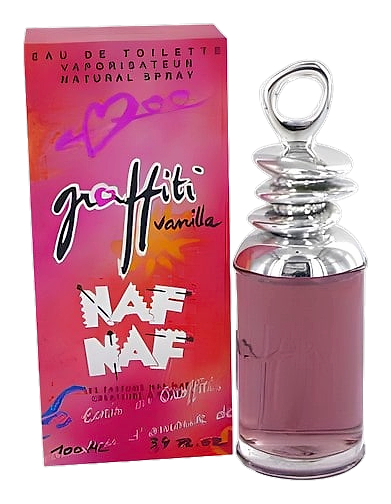
NafNaf launched Graffiti Vanilla in 1995, at the height of a decade when youth culture was rewriting the rules of mainstream fashion. The brand had spent two decades building affordable Parisian style for people who wanted to look good without armor. Graffiti Vanilla was the olfactory equivalent of spray paint on a city wall, an unapologetic burst of color, sweetness, and attitude. The concept was street art translated into scent. Bright berries, a generous pour of vanilla, and just enough floral softness to keep it wearable. It was joyful. It was democratic. It was made for people who wanted to smell like joy, not like they were trying.
What makes Graffiti Vanilla interesting isn't any single note, it's how the materials work together to create something that feels effortless despite being, technically, a fairly complex little machine. Pink grapefruit appears in the top, an unexpected choice in an otherwise sweet composition, it keeps the opening from being cloying. Woodland strawberry brings genuine berry character rather than the generic "fruity" impression many contemporaries relied on. Cashmere wood is doing something subtle here too: it adds a velvety, almost tactile warmth that elevates the entire base without announcing itself.
The evolution
The opening hits immediately: pink grapefruit, tart and bright, followed quickly by the berry quartet, raspberry, strawberry, blackcurrant all tumbling over each other. It's youthful. Unapologetically so. The first twenty minutes are a sprint of sweetness, all fruit and energy. Then the florals arrive. Peony, violet, lily of the valley, they don't replace the berries so much as soften them. The sweetness stays, but it gentles. Peony adds a certain lushness, lily of the valley brings a clean, slightly green undertone that keeps things from getting too heavy. The vanilla starts to assert itself here, wrapping around the florals and preparing for its starring role. By the drydown, the berries have mostly faded. The florals have softened too, becoming a background warmth. What remains is musk, vanilla, and cashmere wood, a close, intimate finish that lingers for hours. The vanilla here isn't loud. It's the smell of something sweet that lived on your skin long enough to become part of it. Moderate sillage. Lasts 4-6 hours on most skin types.
Cultural impact
Graffiti Vanilla is a time capsule from 1995, a moment when mass-market fragrance borrowed freely from street art, youth culture, and accessible joy. It sits in a tradition of fragrances that treated scent as self-expression rather than status. The 90s saw mainstream perfumery embrace sweetness, berries, and vanilla with an abandon that niche culture would later critique, but Graffiti Vanilla makes that critique feel unfair. It's the sweetness of someone who doesn't need to prove anything. Discontinued now, it survives in the secondhand market, a reminder that the best fragrances aren't always the most expensive.